Sunday, June 17, 2012

The Legendary Nasi Lemak Ali

When I was younger, my mother used to buy nasi lemak mamak almost every Friday, usually for breakfast, and extended to lunch. In those days, there were a lot of shops with Indian Muslims selling very good and tasty nasi lemak. Once in a while, she will buy from Nasi Lemak Ali as it is located at what today is known as former Pasar Besar Alor Setar, along Jalan Pegawai. There will always be fried chicken, some beef and kuah campur, or mixed gravy.

Despite her parents originally from Alor Setar, my wife was born and raised in Sungai Petani. Even she remembers fondly of Nasi Lemak Ali from her weekend visits to her uncle's in Alor Setar. Every morning during their stay, her uncle (my uncle too) will buy several packets of nasi lemak from Nasi Lemak Ali, with chicken and mixed gravy in together. Her brothers and her just love the breakfast feast.

Times have changed: the rapid development of Alor Setar in the late 70s and early 80s saw many Indian Muslim nasi lemak vendors moving from their original premise to other places. Some, like Yasmeen and Nasi Lemak Royale found new life (and better business) in their new places/names, while others, like Kedai No. 36, the mamak shop in front of Pasar Besar, simply disappeared. In the past, there were many good nasi lemak mamak in Alor Setar, Nasi Lemak Ali was just one of the competitor, today, it stands as one of the cilinary icon in Alor Setar.

People would come from all over the nation to try Nasi Lemak Ali. The latest legend I heard was that a group of Singaporeans, on the way to Hatyai, drove all the way from the island state without stopping at any R&R, just to eat ay Ali's. I normally avoid Nasi Lemak Ali during the holiday seasons. At one point, during Eid-ul-Fitri season, I saw a very long line coming out from the restaurant all the way to the shop building's corner and more.

I was there with my wife and my son, after so many years, to sample the dishes again. Why I haven't been there for a long time? Well, nasi lemak mamak normally is spicy but not hot. Nasi Lemak Ali is the only one that has a hot reddish-brown gravy, and that taste doesn't really appeal to me. However, for the past few months, I have heard some rumours that the rice and dishes have changed, and I was wondering whether it was true.

The setting at the restaurant has sure changed a lot in the many years since I've been there. It is brighter and there are tables and chairs set outside on the pavement as well, along with seating on the 2nd floor. We had nasi lemak, with fried chicken, mixed gravy and some fried strips of beef. We also had some dalcha as well. Each nasi lemak mamak in Alor Setar will always have fried chicken, fresh from the stove and you can find one of the restaurant employees frying the chicken in front of the shop, so you can be assured that the fried chicken is not yesterday's.

I must say that the rumours were just rumours. The rice, fragrant and flavorful, tasted as it was back then. The mixed gravy was nice and the fried chicken, crispy on the outside and moist on the inside. There are many dishes available for your choosing, but I would still recommend the fried chicken and mixed gravy. There's eggs, prawns, beef, mutton prepared in various ways.

The hot gravy, which is red in color is distinguishable, making Nasi Lemak Ali stand out from other nasi lemak mamak of Alor Setar. My cousin and his family from Kuala Lumpur simply love Nasi Lemak Ali because of that distinct difference. I'm not sure what curry it is, but I am not really in favor of it. However, everybody there loves it, so I guess that this is the taste that made Nasi Lemak Ali outstanding. Hey, hot or not, the empty plates on my table explains everything.

Nasi Lemak Ali is located on Persiaran Sultan Abdul Hamid (formerly known as Jalan Pegawai), which is next to the former Pasar Besar Alor Setar, Ice Factory and Rumah Kelahiran Tun Dr Mahathir.

I was told by my friend in Terengganu that his family and him have stopped eating in Penang when they found out Nasi Lemak Haji Ali. If you have the time, make yourself to Nasi Lemak Ali for a plate of culinary legend.

Sunday, April 8, 2012

Abang Nasi Tomato Mergong

I have explored a lot on the Indian Muslim food in Alor Setar, and believe me, I still have more. A few friends, and even my wife, asked whether there are any Malay eating places that might get my attention. I admit that I did write one or two, but with so many Malay stalls, restaurants and tomyam places out there, it can be very tricky. Another frustrating factor is the inconsistency of taste and even the performance of the vendors. I have written before about a very good Malay Char Koay Teow in Alor Setar, but he has since been opening irregularly and last I heard, disappeared from the place. Or the the tale of the 2 nasi campur restaurant in Pumpong which at one time were the happening at lunch hour that draws customers even from KL during the holidays. Today, even the locals are grumbling about the food quality and price there.

Excluding Indian Muslim or Mamak restaurants/stalls, it is rare to find rice with dishes being sold at night. You will find thai food stalls/restaurants or other type of food available, but not nasi campur style restaurant.


For those who are tired of eating Nasi Lemak, or looking for an alternative to it, there is a place popular among the locals of Alor Setar. Located in front of CIMB Mergong Branch at Seberang Jalan Putra is Abang Nasi Tomato. Contrary to nightly rice dishes of Alor Setar, this stall is owned by a Malay, and he has been in this business for decades. The huge pot serves hot, hunger-comforting tomato rice, usually from around 7:00p.m. to very late at night, except on Tuesdays.

Nobody really has the exact history or origin of Nasi Tomato, or Tomato Rice. One theory has that Nasi Tomato originates from Pahang, which was at first enjoyed by royalties. Another has it that it is a creation of two ethnic groups, the Chinese and the Indians. Another less-known theory is that it is a variation, or modified from the Middle Eastern Beriyani, modified out of necessity and flavor of the locals. Noreover, it is a feast food, usually using tomatos and yoghurt with a blend of spices. I don't know, the verdict is still silent.


Like the old-school Nasi Lemak Mamak shops, the queue is always there. The customers are from all walks of life, and you even have many Chinese and some Indians enjoying their hearty meals there. There are around 8-12 dishes available, usually consisting of fish, beef, chicken (or its parts) along with vegetables. Nasi Tomato is usually accompanied by Ayam Masak Merah (Chicken in Spicy Red Sauce) and Acar or pickles made from pineapple, cucumber and carrot, and don't worry, they're there. Somehow I noticed there are more people opting for Fried Chicken and fried vegetables instead of them. Maybe people want Nasi Tomato with dishes that suit them more than the usual kenduri fare. Despite the fact that this a Malay business, you can still find the Mamak element with many customers requesting for "kuah campur" or mixed gravy to go with their rice. The man at the counter is highly experienced as his mixture has never disappointed me in the years that I have been going there.


As I had chicken on my visits before, I decided to have my rice with fried fish, fruit acar and fried cabbages, of course with kuah campur. My wife had a similar one as well. We are not talking about fried ikan kembong here, it's a nicely cut chunk of a fish, I forgot to ask the name of the fish though. The rice was still hot, and the accompanying dishes were perfect. The fish was nicely marinated with the usual salt and tumeric and the curry mixture was excellent.


I have been there so many times, and during those visits I manage to see politicians from government and opposition having dinner, high ranking officials, businessmen with their families and/or friends having dinner there. I also noticed that those who eats there are mostly locals. Well, I haven't the chance to eat there during holidays so far, so I might have missed seeing them.

If you would like to try Nasi Tomato Abang, I was told that the stall is listed in the GPS, maybe you can check and confirm it. It is located right in front of CIMB Bank Mergong Branch in Seberang Jalan Putra. There are a lot of stalls there, just look for the one right in front of the bank, with dishes on the counter, a huge pot of steaming tomato rice and a seemingly never-ending queue. You can go there by following the directions on the map below:


The food is wholesome and hearty, so make sure to bring a good appetite and an empty stomach when you go there. And I better remind myself to bring the digital camera on my outings, the night photo shots with this handphone is terrible.

Tuesday, April 3, 2012

The Ultime Sloppy Burger in Ampang - Burger Belemoih

I depend a lot on my cousin and my friends when I look for a nice place to eat in Kuala Lumpur. Years of travel has actually taken me off hotel and fancy restaurant food. My cousin, Syed Abdul Rahman Putra, who happens to live very near to my dad's apartment in Setiawangsa seems to find new eateries every time I arrive in KL. We ate at so many places such as Saba (Arabic food), Fareed (Nasi Lemak Royale style in Sungai Buloh, article will be ready soon), Homst, Andullah Chan's to name a few.


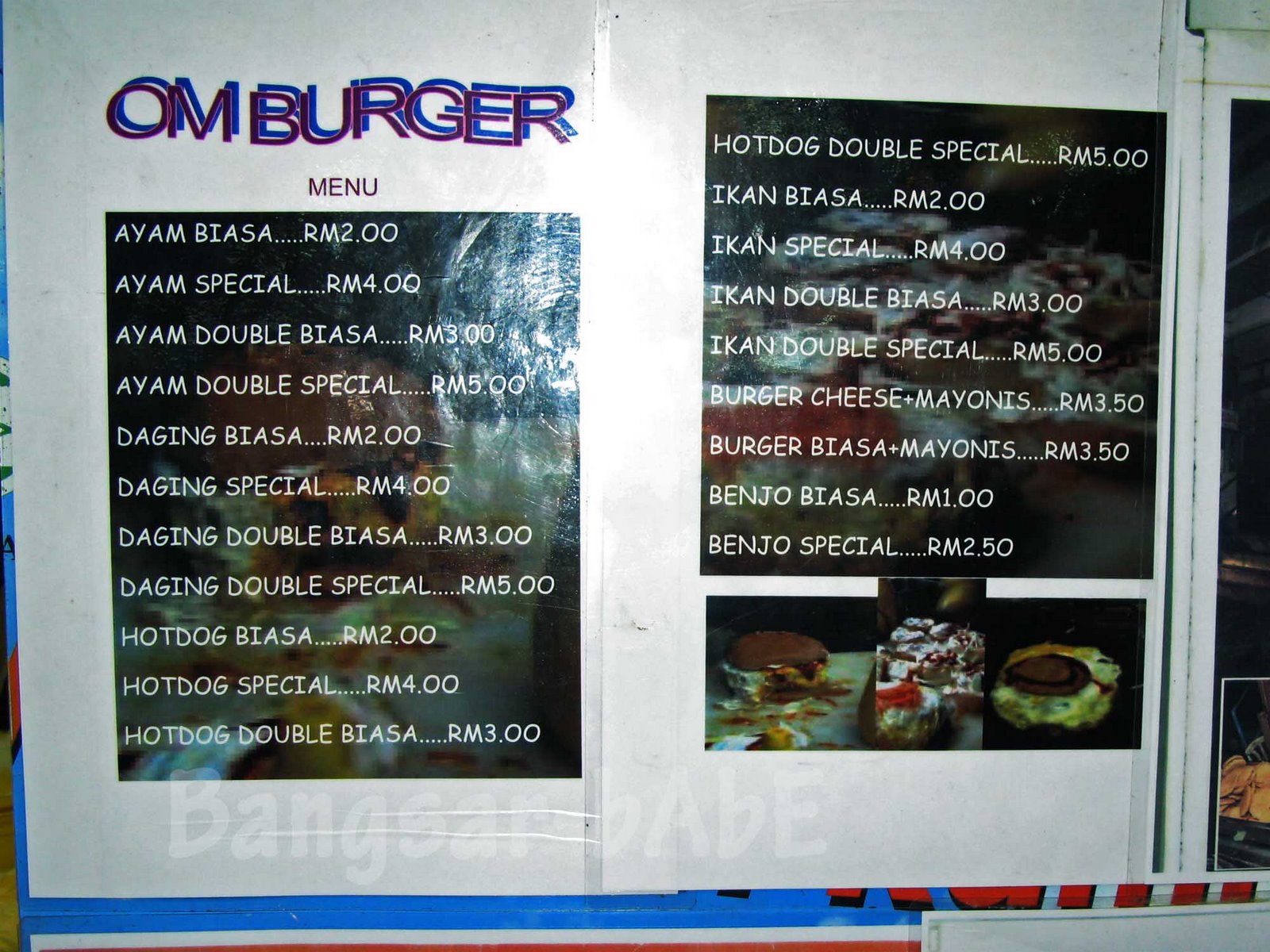
Despite the fact that I go to OM Burger Ampang during almost all of my trips to KL, I never really wrote about it, as I find that he is already well known. I found blog after blog that features him. My cousin and I refer his stall as "Burger Belemoih" which is the northern dialect for Sloppy or Messy Burger. I don't think that name is original anyway.

The stall is run by a husband and wife team, always referred to as Pakcik and Makcik by his clients. I am not sure how long he has been in this business, but I'm guessing it has been a long time, judging from his very relaxed pace in preparing the food. He has almost all types of Malaysian-style burgers available: beef, chicken, hot dog, with egg, with cheese or both, the double and double specials. On the nights when we skip dinner, we can always safely bet on the double specials.

People might say that, a burger is just a burger. Om's seems to serve an ultimate to this experience. He is very generous with the sauces, with the bun liberally slabbed with margarine before going onto the griddle, and a rich slap of mayonnaise after that. I usually prefer mine without ketchup and chili sauce and extra mustard for my hot dog. From the taste, I am guessing that grade has something to do with the taste as the burgers and hot-dogs don't really taste exactly like other stalls. He could be using a better grade burger meat and sausages from Ramly (or other manufacturers) for his business.


I must advice here that this is not really the place for healthy food. His slightly indented griddle has grease pooling in it, in which he grills the burger meat, fries the eggs and cheese. For my cousin and me, what matters is that it is delicious, filling and satisfying. I mean, the burger is so sloppy (and big), we had to eat it with fork and spoon.

I can safely say that, should anybody who craves an ultimate burger to satisfy that hunger pang, then Om Burger Ampang is your destination. This Kedahan is impressed. They are open daily from 8pm to 5am and located outside 7-11 outlet in Jalan Kolam Ayer Lama in Ampang.


Here are 2 links if you want more info and pictures on OM Burger in Ampang.
http://www.foodpoi.com/2010/08/om-burger-ampang-kl-best-and-most-sloppy-street-ramly-burger/
http://www.bangsarbabe.com/2009/03/om-burger-ampang-jaya.html 

My profound apologies for using pictures from other blogs, something went wrong with the memory card of my camera and I lost all the pictures I took.

Monday, April 2, 2012

Hailam Food of Alor Setar

Some might find that small operated food stalls and restaurants in Alor Setar can offer surprises. For me, nost of the places where I enjoy dining most are small. Maybe because the food is more homely, or maybe the proprietor cooks better in a small-crowd environment.

Compared to the cosmopolitan areas such as Kuala Lumpur, Alor Setar lacks Chinese food that Malays enjoy. I have tried Homst in Taman Tun Dr Ismail and Kota Damansara, Abdullah Chan's restaurant at Wangsamaju, and I really wish they would set up a branch or two up north. They were really packed, and most of the food I tried really hit the spot.

Alor Setar does have a few restaurants with a mish-mash or combined Thai/Chinese/Malay/Western food on their menu, such as Riverbank Restaurant at Taman Habsah and ET Restaurant at Taman Golf. I must admit that they're good and authentic enough. At one time, in the 1970s and 80s, the coffeeshop at Rukun Tetangga was very popular. The Hailam cooking was enjoyed by so many, and by all ethnicity. It was a husband and wife-ran operation where the husband was the cook. I vividly remember his Fried Mee, black in color, with a slightly thick sauce at the bottom. Some call this Mee Goreng Hailam, but the fact you are there to order Hailam food, I usually just call it Mee Goreng. It is the type of dish which makes me want to call for seconds.

When the husband passed away, the wife took over; but the food differed. Despite serving to full-house crowds at lunch-time, most of the base customers have shifted away.

Hailam cooking is by the Hainanese. Historically, many of the Hainanese in Malaysia were involved in the hospitality industry. For Kedah alone, the state-owned rest houses in the state and Kedah House in Cameron Highlands were run by the Hainanese. They were the operators, running errants from maintaining the premises, cooking and even the laundry. I cannot verify this, but I was told by my Chinese friend that Hainanese never sell pork in their food business and most of them cater to all races in Malaysia, most by getting supplies from Halal suppliers. The concept, as I was told, are now being adapted nationwide where pork-free Chinese restaurants have become favorite places. Among the most significant, unfortunately less remembered contribution by the Hainanese to the Malaysian culinary feast are the Chicken Rice and Chicken Chop.

Another Hainan restaurants where you might find more Malays eating there is Kedai Kopi Kuang Ming, located at Stadium Darulaman in Jalan Stadium. The location is just next to Hotel Sri Malaysia. Despite passing-by in front of their shop for the past 30 years, I never knew much about them. A few years back, my colleagues and friends were telling me about a nice simple Chinese shop that sells lip-smacking dishes, and to my surprise, they were talking about Kedai Kopi Kuang Ming.

The shop has been in existence for more than 30 years, and it was always located at the stadium: first outside the stadium and when the shops were built, the shop continued at its new location. The shop is a husband-and-wife-run operation, both of them, as I understand, are already in their 60s, which we passionately call Uncle and Aunty. Aunty cooks the dishes, and unlike the male-dominated restaurant cooks who cooks almost one dish a minute, her cooking is more home-style, no rush but never that long.


Uncle took over the shop from his father, and has been doing so ever since. A famous story stated that, at one, somebody asked his father why he never sells pork-based dishes in his outlet, he answered that he has been selling his dishes for decades and his base-customers have already known him well for his dishes, and he will not change it for anything. One or two of his sons converted to Islam and married Malay ladies.

In his heydays, Uncle use to have a wide-selection menu and frequented by so many, including government officials, police officers and businessmen. Now as Uncle and Auntie are over 60, Uncle told me that he doesn't have the strength to do the same. The big round tables have been replaced by small ones. The menus are nowhere to be seen. Uncle told me that now he usually serves his regulars who usually knows what is available. It's quite rare for him to find a very enthusiastic chap who even brought his wife and son as his new customers.

On weekdays, my wife and I usually order the usual simple dishes. One might assume that Auntie might take her time as you can hear the ladel scarping against the wok slowly in the kitchen, but she gets it dome in just a few minutes. Fried rice is usually simple, but this one is packed with eggs, pieces of chicken, shrimp, squid, fishcakes and mix-vegetables. Usually, if one of the seafood is not available, it will be counter-balanced by what is readily available.

The fried noodle dishes usually have 2 styles: wet or dry. My wife prefers dry style, while I prefer the other. Just like the fried rice, it is packed with the combined cuts of chicken and seafood, along with freshly cooked vegetables. The wet style usually has a little sauce, black in colour. It is not too thick, meaning that Auntie uses not too much corn starch, making the flavour more evident and giving the desire to customers to finish up the dish to the last drop. The fried koay-teow, dry version, has an additional taste: peanuts. I believe that crushed peanuts are used in the dish. This is not surprising because I remember, back in the 1970s, my mother used to sprinkle crushed peanuts when she makes fried koay-teow as well.

My wife's favorite is Fried Bihun. The dish is simple enough, and yet I can never emulate it in my kitchen. The strands of rice vermicelli are soft, combined with the chicken, prawns and vegetables, creating a tasty concoction that my wife enjoys with her condiment of sliced bird-chilli in soy-sauce. Unlike many Chinese cooks who have evolved to a more-Malaysian style of combining chili paste in their cooking, Uncle and Auntie remained loyal to their traditional method. If your tongue requires a little heat, you can request sliced chili, bird chili or pickled chili. I prefer the last one.

All of our dishes are always accompanied by Mixed Vegetables, which we order on every visit. It is made with fresh vegetables, depending on what is available, mushrooms; usually 2 types, chicken, shrimp, squid, fishcake, all stir-fried to perfection. The crisp vegetables, made wholesome by its accompanying cuts of meat and seafood, completes our lunch.

On Thursdays, Uncle and Auntie sell Mee Kari for breakfast, usually between 8.30 to 10.00 a.m., depending on availability. I have nor tried this as my many attempts resulted in frustrations. Yes, it sells out fast...too fast to my liking.

On weekends, if my family and I want something simple and satisfying, we would usually go to Uncle and Auntie's for a spot of lunch. Uncle himself won't remember all of the items on his previous menus, but he would recommend certain items such as curry, sotong masak sambal or/and fried chicken. We look forward to try the curry one of these days.

Paying RM4.00 for a generous portion of fried rice or the noodle dishes, loaded with chicken, egg, seafood and vegetables is really a bless. You leave the shop, wondering whether you can work on an extremely full stomach or not. I feel that it is better than some of the Menu Rakyat 1Malaysia I saw in Kuala Lumpur.

I guess Uncle and Auntie are the last in their generation to inherit the shop. Their children don't seem to show any interest as they are now working elsewhere. One of them is a university lecturer, I'm not sure about the others. I guess I better enjoy the good at Kedai Kopi Kuang Ming while it is still available. The food is good, the herbal tea cools you down on hot Alor Setar days and the ambience is very relaxed. Deep inside, I wish somebody in his family will continue the business later on and keep the delicious dishes coming for the loyal customers.

You can reach Kedai Kopi Kuang Ming below:
 and here's a closer view of the location:

Sunday, February 19, 2012

Malathi's Lunch Thursdays : Simple Indian Food With Rich Flavors


My wife and I usually spend our lunchtime at Malathi's almost every thursday. I have written before on Malathi's, but on breakfast , and lunch is such a treat compared to breakfast. Why Thursdays? On Thursdays, we have a choice, either normal rice or the Beriani. Malathi serves a simple, yet memorably mouth-watering Indian food for lunch.


I have stated before that there is not many Indian restaurants available in Alor Setar compared to Sungai Petani or Kulim, to me, one of the most powerful attraction to eat there is the closer-to-home taste. One might notice that the rice and dishes are not doled out in huge pots, instead they are prepared in medium and large ones. At times, if you drop by after 1:30pm, you might be disappointed to see that most of the dishes are already cleared. It is understandable as this is a family run business. The proprietors, Puspa and her husband, Maran prepares everything. The cooking is done by Puspa and her mother at their house, which is close-by. Supplies are sourced daily and cooked by Puspa and her mother. For me, the limited quantity is a plus: the taste of home-cooked is there, no mass-produced curries here. Another factor is that there are no leftovers by the time Malathi is closed, ensuring fresh start for the next day.


Some people might find that Beryani made from non-Basmathi rice can be a turn off, but for me and wife, what matters is the taste and flavor, and how well the curries and vegetables mix with the rice.


The Beryani at Malathi's might be a tad different from the usual affair, and looked much simpler. A set of Beryani has the rice, chicken in a rendang-smelling gravy, dhal and vegetables. I was made to understand that previously, the chicken was marinated and cooked with the rice, but on popular demand by customers, the chicken is cooked seperately. In a way, the chicken in its marinate gravy became a much-sought-after dish on its own. The chicken is marinated with spices and slow-cooked in a pot. It smells like rendang but has a very different taste and not spicy hot. This is the dish that usually runs out first before anything else. For me, to go there and find that the chicken dish is still available will be such a bonus. It tastes well with white rice as well.


The seperate preparations for the rice and chicken led to theorize that Malathi's Beryani is a variation of the Hyderabad Beryani, where the chicken is marinated seperately from the rice, but slow-cooked together. Then again, there are so many variations between continents, countries, regions and families. One thing for sure, this Beryani is good.

There are the basic vegetable dishes, usually 4 of them daily. The greens are usually chopped quite finely, root vegetables are usually in bite-sizes. Among my favorites are the curried or spiced pumpkin and the spiced-bitter gourd. On Thursdays, you will find combination of cucumber, onions and chilli in yoghurt, which is a sort of acar.


The curries served at Malathi's are extraordinarily good. According to Maran, his mother-in-law concocts her own curry powder. I have read that in India, you will not find curry powders in shops as each house blends their own. This makes the curries at Malathi's unique in a way as this seperates their curries from the old school Mamak shops in Alor Setar, despite both groups using no santan or coconut milk in their curries.

Basically, there are 3 types of curries: fish, mutton and chicken. The curries are not too thick, nor too watery, just perfect. The spices are well balanced, and memorable: the fish curry has that slight tangy taste of asam, the chicken curry is slightly hot and the mutton curry (actually thick sauce) is hot. The strong spices on the perfectly prepared mutton ensures a good spicy flavor without any smell from the mutton. I must say that the mutton goes perfectly with the Beryani. There's also fried fish and fried chicken. On Thursdays, there is also Ayam Masak Merah. I must admit that I have not tried it yet. I was told by my wife that the dish is good, but after kenduris where they serve Ayam Masak Merah in every one of them, my appetite for it has still not returned.


For some who loves a an additional kick to their eating experience, there is jar of fried dried chilli, available as a side dish to your rice. There is also a jar of mixed fruit acar on the table, which is a sour concoction to accompany the rice and dishes. As I have mentioned before, with the family busy preparing food on a daily basis, I find it understandable that Malathi's uses a commercially produced acar. There is always the freshly-made Rasam, the soup-like concoction made with tamarind and spices, either to have with your rice or drink it afterwards to settle the stomach.


On certain days, you will find a more Malaysian dish at Malathi's to go with your rice. At one time, I had Ayam Masak Kicap and at another, there was Sambal Tumis with Ikan Goreng. This is, after all, Malaysia.

The lunch crowd at Malathi's is a colorful mix of Indians, Malays and Chinese, usually coming in around 12:30 noon and earlier on Thursdays. At times, you'll find doctors, businessmen and even government officers enjoying the food at Malathi's.

I definitely cannot compare the ambience and the services that you might find at big restaurants and hotels, the taste and flavors Malathi offers can easily match up with them, even without the Basmathi.

Malathi is open everyday except Saturdays, with Breakfast from 7:30 a.m. to 11:00 a.m., Lunch from 11:45 a.m. to 2:30 or 3:00 p.m. and at 7p.m., Malathi opens again serving light food  like thosay and chapati. If you're going for lunch, try being there before 1:00 p.m.

Getting there:

Friday, January 20, 2012

Mee Sham's Roti Dholl, And More

My wife kept telling me of a restaurant in Jalan Alor Setar-Gunung Keriang that is famed for a novelty dish called Roti Dholl. The dish is very popular there. I had no idea what it was all about, so, one nice Saturday, we decided to drive up there and sample it ourselves.

The name of the shop is Restoran Mee Sham, located at a shop house in Jalan Gunung Keriang, about 10-20 minutes drive from Alor Setar city. It occupies the whole ground floor with a choice of sitting inside or outside the shop. Parking, depending on time, is quite a cinch. It is an Indian Muslim, or Mamak restaurant, but most of the employees are Malay.


Roti Dholl, as I was told, originated when the owner of Mee Sham was operating originally behind AMBank in Jalan Putera. With the opening of the restaurant, they shifted their operations to the shophouse, while his nephew still runs the stall in Jalan Putera.

The dish is a piece (or two if you want) of roti canai, shredded, with an egg, fried sunny side up and flooded by the gravy, usually dal with a little sambal. It kinda reminded me of the Roti Bintang back in Satun, but Roti Dholl differs in the making and presentation and even the way to eat it.

At first, I do feel a bit odd having the roti, with the seasoned egg yolk flowing into the gravy. Somehow, it seems to add richness to the gravy and perhaps the best alternative to the plain Roti Telor.


Roti Dholl is available in the morning, until about 11:00am, then starts again at 4:00pm. True to the claim, Roti Dholl is extremely popular with the locals there. According to the owner, about 300 roti dholls are sold during the morning shift. There are several newspaper cuttings which displays media reports on the popularity of Roti Dholl in that area posted on the wall.

There are quite a number of choices that you can find at Mee Sham: they have Nasi Kandar or Nasi Lemak, as it is better known, Nasi Ayam and noodle dishes. I tried the Mee Rebus, while my wife had Mee Goreng.

The Mee Rebus has a rich, thick gravy, with bean sprouts, boiled egg, crunchy fritters, beef and topped with a slice of lime. The taste was excellent, you can taste the beef stock in the gravy and the portion was quite sizable. I dare say that the Mee Rebus can stand to be a fresh alternative to Mee Abu's.

The Mee Goreng too stands up to the mark, albeit being slightly sweetish.

The nasi lemak looks tempting, but by that time, all of us were full.

Scouting around the nasi lemak counter, I noticed that the curries were of old school Mamak style, with an addition of new ones. I might just return to sample these soon.

Restoran Mee Sham is located at Jalan Alor Setar-Gunung Keriang. If you are from Alor Setar heading to wards Gunung Keriang, the shop can clearly be seen on the left after passing by a Petronas station on the right.

Thursday, January 19, 2012

Traditional Fresh Water Fish Dishes...In Kuala Lumpur?

Fresh water fish is really making waves nowadays. What used to be cheap, almost valueless item sold in the market 30-40 years ago are now some of the most expensive items on the menu. There are even farms breeding catfish, patin and several other types all accross the country that supply restaurants and marketplace.

On my return trip from Kuala Lumpur, I use to stop at R&R Sungai Perak for the Gulai Tempoyak Ikan Patin, which is my favorite. My friends from Perak and Pahang will criticize my choice as Kuala Kangsar has the dish and much better in taste. I did try the one in Kuala Kangsar, it was very hot so I reverted to the one at the R&R.

Most restaurants that serve kampung-style food in Alor Setar usually have catfish, either fried, grilled or in curry on their menu. It is not surprising as popular fresh water fish in Kedah is more on catfish, haruan and puyu as they were readily available in paddy fields and canals.

I must admit that I am not a fan of eating in KL. I feel that the Malay food there is severely commercialized and lost most of its authenticity. I do feel that Thai food has, in a way, overtaken Malay food in many ways, not to mention the advent of Indonesian food such Bakso and Ayam Penyek. Also, there's not many place there offers fresh water fish on their menu...of course, I could be wrong on this, so I apologize in advance.

My friend, Zaliny, during his trip to Alor Setar, promised to take me to a place that will change my perception about eating in KL. Now Zaliny and I have been friends ever since we were in Form 1 back in MRSM Balik Pulau, Pulau Pinang. Just like me, he looks for food that has is really good, with true flavors and authenticity. After completing my business, true to his words, he took my cousin and me out for dinner.


Zaliny took us to a restaurant called Restoran Samudra de Menara Tinjau, located at the Kompleks Pelancongan on the Jalan Ampang-Ulu Langat. I must say that the location is quite a change from the normal urban scenario, being on a hill, past the over-crowded lookout-point. The area is quiet, with a very big parking area. On certain days, the restaurant can be quite packed with tourists. Zaliny has contacted the proprietor in advance and ordered some items that, as I was about to find out, will shatter my perception.

I was made to understand that the cooking is Pahang style, but I understand it, Pahang and Perak's cooking is similar in so many way, only differed in certain preparations.

For dinner, Zaliny has ordered rice accompanied by these dishes:


1) Gulai Tempoyak Ikan Patin
I am so used to the version at the R&R Sungai Perak (northbound), which is quite watered-down and modified to suit the pellet of travellers. This version however, spares no quarter. The fish, caught wild, was fresh and firm, leaner as it is not too oily compared to the bred one used at the R&R. The spices were wholly complete and a lot of tempoyak is used, and as a result, the gravy is thicker and richer which we can either eat with rice or take it in like soup. The flavor of the fish is there and the gravy is sourish, slightly hot and slightly sweet, as it is supposed to be. We ate it with rice, and later, as soup. Simply irresistable.


2) Masak Lemak Ikan Baung with Rebung (Bamboo Shoots)
I am familiar with masak lemak, although I skip this dish in stalls and shops as they proproeters seem to be stingy on the coconut milk. Anyway, all the masak lemak I have tasted before never had fresh fish. The masak lemak is rich in flavor: spices, herbs, bamboo shoots, fish and coconut milk. The bamboo shoot is almost sweet, without much smell.

3) Grilled Ikan Krai
In some places in KL where they boast of Ikan Bakar, I find them disappointing. This was because of the lack of spice used, and sometimes when the spices are right, they were too stingy to dab them properly on the fish, maybe for cost purposes.

This dish, with a very healthy dose of spices and herbs, lathered richly onto the fish and grilled to perfection, is the most outstanding. I can just eat the fish without bothering for rice. The firm flesh, the jubilant smell of burnt spices on the fish adds richness to the eating experience.

4) Udang Galah Fried With Sambal Petai
Udang Galah is a species of fresh water prawn, and it is such a delicacy, especially in Kedah. Although it was abundant in Kedah, the 1980s saw its decline and the udang galah could not be found in the rivers in Kedah anymore nowadays. Back in the 1960s to mid-1970s, I had a grand-uncle who operates a stall in a kopitiam beside Masjid Zahir, selling a noodle dish simply called Mee Kakak. The name was derived from his nickname "Syed Kakak" where in Palembang, kakak means brother. To make his dish, he would go and catch udang galah himself.

Back to the Udang Galah at Restoran Samudra, the firmness of the flesh defines the freshness of the prawn. Despite the fact that the prawn was marinated with spices such as tumeric and chilli, the spices never over-powered the taste of the prawn. Combined with the traditional style dry sambal petai, it is a dish that you could not stop going back for more.

4) Ulam with Sambal Belacan and Tempoyak.
What's a Malay traditional dinner without ulam? Fresh ulam, consisting of cucumber, bitter-gourd and some other leafy green; now that perfects the feast. A dab, or more of tempoyak with your ulam and perhaps mix it with a little sambal belacan fills your moth with an explosion of taste and flavors. The tempoyak, or fermented durian has a sweet and sour taste, and a perfect combination will be with the sambal. You can just sit there, listening to the crunching sounds from everybody's mouth.

Despite having fresh water fish, I must say that none of them smells like grass. I guess they really know how to clean the fish perfectly.

Many years ago, I used to go to village areas such as Pendang and Kuala Nerang where they serve fresh water fish as kenduri dishes. They were very good, but they were not as rich as the dishes served at Restoran Samudra. I think I can safely say that these dishes are fit for kings, rich in tradition, overflowing in taste and flavor and a very tight quality control. Mind you not to burp in the car after the meal, unless you have a very strong air freshener.

Zaliny was right, I can get good food in KL, and what's more surprising, the cooking is traditional. Now how can I compete with that? In Alor Setar city, food outlets label themselves as "Kampung Style" just because they have Daging Bakar, Catfish dishes and ulam, the rest remains a fusion of almost every state in Malaysia. At Restoran Samudra, when they say traditional cooking, they really mean traditional.

If you want to try the dishes there, make a start to Restoran Samudra de Menara Tinjau located at Kompleks Pelancongan, Jalan Ampang Hulu Langat. If you're coming from Ampang, it should be on your right, you can't miss it. It is time to eat traditional.


I would suggest calling ahead to know what are the fishes available on that day, and perhaps cut back on the waiting time for the food.

Samudra d' Menara Tinjau is on Facebook, at this link