Showing posts with label malay food. Show all posts

Saturday, August 18, 2012

End of Ramadhan With New Inspiration

This year has been, indeed, different. We had a new stall selling Tepung Talam and other sweet dishes at where we were doing our business, which is a welcoming sight. However, about 10 days ago, we were chased off the area by the Alor Setar City Council, or Majlis Bandaraya Alor Setar (MBAS) for "creating traffic hazards". Coincidentally, their visit was about half and hour after the Datuk Bandar of Alor Setar (head of MBAS) came to buy Nasi Arab from Chet. It was an irony which we find it hard to swallow.

We were forced to relocate about 300 meters away to a Medan Selera located next to the Esso gas station. I find the place quite bizarre as there was nobody selling anything in the food court. Sales for both Nasi Arab Pak Tuan and my dishes dropped as many thought we stopped selling and many more didn't know we were there despite Chet's banner at the old location. I realized MBAS just wanted to somebody to "liven" up the place as it is dead almost every Ramadhan season. The location, next to a school and a traffic light junction after the new bypass made the area laden with a horrendous traffic congestion, putting off a lot of people from going there as parking was a problem.

Our old location? Well, it remained the same as we found out that we never created any taffic obstacle. In fact, there so many stalls located by the side of the road along Lebuhraya Sultanah Bahiyah that MBAS never bothered to see. The Ramadhan Bazaar next to Insaniah posed a more dangerous traffic scenario where masses of vehicles simply park and double park along the road with accidents almost daily. However, since the Bazaar was endorsed by MBAS and the vendors are paid for, MBAS never bothered to monitor.

Anyway, this year saw the emergence of my sister's beef curry-puff and baked macaroni with cheese (pasta) above the others. Close at third will be my Bengkang Susu. One of my customers remarked that, at RM5 (RM2.50/slice), it is more filling and tastes better with a bigger size compared to the Lasagna bought at an international fast food joint. Usually if I crave for pasta, I would buy 2 pieces first before selling the rest. I also understand that my sister supplies about 400-500 pieces of karipap daily to a stall operator at the Bazaar Ramadhan at the stadium, and the vendor still find it hard to meet the demands from his customers.

As the last business day is today, Friday 17th August, I was quite hesitant to make too many kuih. Fridays are usually slow as people usually prefer to stay home and cook or go and eat outside for the breaking of fast. Being in the new place doesn't really help my confidence either, plus, it was raining in the first half of the day. However, I still prepared triple the amount of what I always bring, plus the extra trays of godam (shepherds' pie) and bengkang susu that some special customers reserved. My wife and my son even decided to go along and assist me. Alhamdulillah, the whole supply was sold in less than one hour.

My stall received visits from a number of friends and close relatives, just like the years before, and I really appreciate them coming over and I really hope that they enjoy the food we prepared.

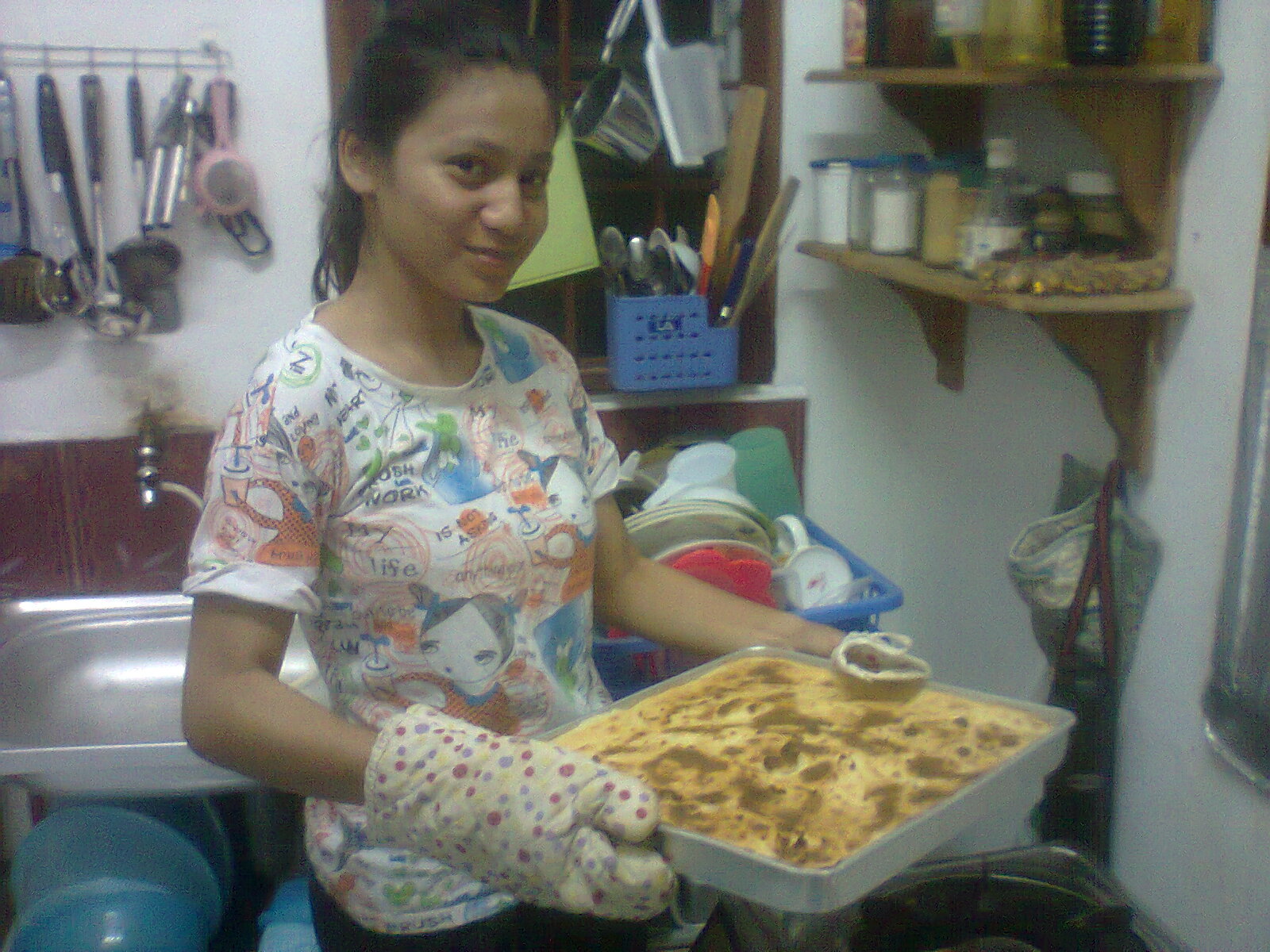
My cousin showed me a picture of his mother's godam, which was more traditional and original compared to mine. That really gives me an inspiration to revise my godam preparation for next year. Her pie follows the authentic style where the mashed potato is used as the base and crust of the pie, with the beef filling in between. My version is a more modernized and simplified version where, due to the size of the cup, it has no base. The beef filling is at the bottom and the mashed potato is on the top as the crust. In fact, the original rustic shepherds' pie in Greece, as prepared by farmers, are more in the style of my aunt's, which is hard enough to be sliced and held. Looks like I'll be experimenting a lot on this for the next 11 months.

If we are to be in the same location next year, I think by that time, many of our usual customers will know of it by that time. To my customers, thank you very much and I really apologize to those who did not have the chance to try my dishes when they came over.

I wish all, Selamat Hari Raya Aidil Fitri, Maaf Zahir Batin, from Syed Alfian Barakbah, Sharifah Rafita Shahab and Syed Muhammad Zulkifli.

Sunday, April 8, 2012

Abang Nasi Tomato Mergong

I have explored a lot on the Indian Muslim food in Alor Setar, and believe me, I still have more. A few friends, and even my wife, asked whether there are any Malay eating places that might get my attention. I admit that I did write one or two, but with so many Malay stalls, restaurants and tomyam places out there, it can be very tricky. Another frustrating factor is the inconsistency of taste and even the performance of the vendors. I have written before about a very good Malay Char Koay Teow in Alor Setar, but he has since been opening irregularly and last I heard, disappeared from the place. Or the the tale of the 2 nasi campur restaurant in Pumpong which at one time were the happening at lunch hour that draws customers even from KL during the holidays. Today, even the locals are grumbling about the food quality and price there.

Excluding Indian Muslim or Mamak restaurants/stalls, it is rare to find rice with dishes being sold at night. You will find thai food stalls/restaurants or other type of food available, but not nasi campur style restaurant.


For those who are tired of eating Nasi Lemak, or looking for an alternative to it, there is a place popular among the locals of Alor Setar. Located in front of CIMB Mergong Branch at Seberang Jalan Putra is Abang Nasi Tomato. Contrary to nightly rice dishes of Alor Setar, this stall is owned by a Malay, and he has been in this business for decades. The huge pot serves hot, hunger-comforting tomato rice, usually from around 7:00p.m. to very late at night, except on Tuesdays.

Nobody really has the exact history or origin of Nasi Tomato, or Tomato Rice. One theory has that Nasi Tomato originates from Pahang, which was at first enjoyed by royalties. Another has it that it is a creation of two ethnic groups, the Chinese and the Indians. Another less-known theory is that it is a variation, or modified from the Middle Eastern Beriyani, modified out of necessity and flavor of the locals. Noreover, it is a feast food, usually using tomatos and yoghurt with a blend of spices. I don't know, the verdict is still silent.


Like the old-school Nasi Lemak Mamak shops, the queue is always there. The customers are from all walks of life, and you even have many Chinese and some Indians enjoying their hearty meals there. There are around 8-12 dishes available, usually consisting of fish, beef, chicken (or its parts) along with vegetables. Nasi Tomato is usually accompanied by Ayam Masak Merah (Chicken in Spicy Red Sauce) and Acar or pickles made from pineapple, cucumber and carrot, and don't worry, they're there. Somehow I noticed there are more people opting for Fried Chicken and fried vegetables instead of them. Maybe people want Nasi Tomato with dishes that suit them more than the usual kenduri fare. Despite the fact that this a Malay business, you can still find the Mamak element with many customers requesting for "kuah campur" or mixed gravy to go with their rice. The man at the counter is highly experienced as his mixture has never disappointed me in the years that I have been going there.


As I had chicken on my visits before, I decided to have my rice with fried fish, fruit acar and fried cabbages, of course with kuah campur. My wife had a similar one as well. We are not talking about fried ikan kembong here, it's a nicely cut chunk of a fish, I forgot to ask the name of the fish though. The rice was still hot, and the accompanying dishes were perfect. The fish was nicely marinated with the usual salt and tumeric and the curry mixture was excellent.


I have been there so many times, and during those visits I manage to see politicians from government and opposition having dinner, high ranking officials, businessmen with their families and/or friends having dinner there. I also noticed that those who eats there are mostly locals. Well, I haven't the chance to eat there during holidays so far, so I might have missed seeing them.

If you would like to try Nasi Tomato Abang, I was told that the stall is listed in the GPS, maybe you can check and confirm it. It is located right in front of CIMB Bank Mergong Branch in Seberang Jalan Putra. There are a lot of stalls there, just look for the one right in front of the bank, with dishes on the counter, a huge pot of steaming tomato rice and a seemingly never-ending queue. You can go there by following the directions on the map below:


The food is wholesome and hearty, so make sure to bring a good appetite and an empty stomach when you go there. And I better remind myself to bring the digital camera on my outings, the night photo shots with this handphone is terrible.

Thursday, January 19, 2012

Traditional Fresh Water Fish Dishes...In Kuala Lumpur?

Fresh water fish is really making waves nowadays. What used to be cheap, almost valueless item sold in the market 30-40 years ago are now some of the most expensive items on the menu. There are even farms breeding catfish, patin and several other types all accross the country that supply restaurants and marketplace.

On my return trip from Kuala Lumpur, I use to stop at R&R Sungai Perak for the Gulai Tempoyak Ikan Patin, which is my favorite. My friends from Perak and Pahang will criticize my choice as Kuala Kangsar has the dish and much better in taste. I did try the one in Kuala Kangsar, it was very hot so I reverted to the one at the R&R.

Most restaurants that serve kampung-style food in Alor Setar usually have catfish, either fried, grilled or in curry on their menu. It is not surprising as popular fresh water fish in Kedah is more on catfish, haruan and puyu as they were readily available in paddy fields and canals.

I must admit that I am not a fan of eating in KL. I feel that the Malay food there is severely commercialized and lost most of its authenticity. I do feel that Thai food has, in a way, overtaken Malay food in many ways, not to mention the advent of Indonesian food such Bakso and Ayam Penyek. Also, there's not many place there offers fresh water fish on their menu...of course, I could be wrong on this, so I apologize in advance.

My friend, Zaliny, during his trip to Alor Setar, promised to take me to a place that will change my perception about eating in KL. Now Zaliny and I have been friends ever since we were in Form 1 back in MRSM Balik Pulau, Pulau Pinang. Just like me, he looks for food that has is really good, with true flavors and authenticity. After completing my business, true to his words, he took my cousin and me out for dinner.


Zaliny took us to a restaurant called Restoran Samudra de Menara Tinjau, located at the Kompleks Pelancongan on the Jalan Ampang-Ulu Langat. I must say that the location is quite a change from the normal urban scenario, being on a hill, past the over-crowded lookout-point. The area is quiet, with a very big parking area. On certain days, the restaurant can be quite packed with tourists. Zaliny has contacted the proprietor in advance and ordered some items that, as I was about to find out, will shatter my perception.

I was made to understand that the cooking is Pahang style, but I understand it, Pahang and Perak's cooking is similar in so many way, only differed in certain preparations.

For dinner, Zaliny has ordered rice accompanied by these dishes:


1) Gulai Tempoyak Ikan Patin
I am so used to the version at the R&R Sungai Perak (northbound), which is quite watered-down and modified to suit the pellet of travellers. This version however, spares no quarter. The fish, caught wild, was fresh and firm, leaner as it is not too oily compared to the bred one used at the R&R. The spices were wholly complete and a lot of tempoyak is used, and as a result, the gravy is thicker and richer which we can either eat with rice or take it in like soup. The flavor of the fish is there and the gravy is sourish, slightly hot and slightly sweet, as it is supposed to be. We ate it with rice, and later, as soup. Simply irresistable.


2) Masak Lemak Ikan Baung with Rebung (Bamboo Shoots)
I am familiar with masak lemak, although I skip this dish in stalls and shops as they proproeters seem to be stingy on the coconut milk. Anyway, all the masak lemak I have tasted before never had fresh fish. The masak lemak is rich in flavor: spices, herbs, bamboo shoots, fish and coconut milk. The bamboo shoot is almost sweet, without much smell.

3) Grilled Ikan Krai
In some places in KL where they boast of Ikan Bakar, I find them disappointing. This was because of the lack of spice used, and sometimes when the spices are right, they were too stingy to dab them properly on the fish, maybe for cost purposes.

This dish, with a very healthy dose of spices and herbs, lathered richly onto the fish and grilled to perfection, is the most outstanding. I can just eat the fish without bothering for rice. The firm flesh, the jubilant smell of burnt spices on the fish adds richness to the eating experience.

4) Udang Galah Fried With Sambal Petai
Udang Galah is a species of fresh water prawn, and it is such a delicacy, especially in Kedah. Although it was abundant in Kedah, the 1980s saw its decline and the udang galah could not be found in the rivers in Kedah anymore nowadays. Back in the 1960s to mid-1970s, I had a grand-uncle who operates a stall in a kopitiam beside Masjid Zahir, selling a noodle dish simply called Mee Kakak. The name was derived from his nickname "Syed Kakak" where in Palembang, kakak means brother. To make his dish, he would go and catch udang galah himself.

Back to the Udang Galah at Restoran Samudra, the firmness of the flesh defines the freshness of the prawn. Despite the fact that the prawn was marinated with spices such as tumeric and chilli, the spices never over-powered the taste of the prawn. Combined with the traditional style dry sambal petai, it is a dish that you could not stop going back for more.

4) Ulam with Sambal Belacan and Tempoyak.
What's a Malay traditional dinner without ulam? Fresh ulam, consisting of cucumber, bitter-gourd and some other leafy green; now that perfects the feast. A dab, or more of tempoyak with your ulam and perhaps mix it with a little sambal belacan fills your moth with an explosion of taste and flavors. The tempoyak, or fermented durian has a sweet and sour taste, and a perfect combination will be with the sambal. You can just sit there, listening to the crunching sounds from everybody's mouth.

Despite having fresh water fish, I must say that none of them smells like grass. I guess they really know how to clean the fish perfectly.

Many years ago, I used to go to village areas such as Pendang and Kuala Nerang where they serve fresh water fish as kenduri dishes. They were very good, but they were not as rich as the dishes served at Restoran Samudra. I think I can safely say that these dishes are fit for kings, rich in tradition, overflowing in taste and flavor and a very tight quality control. Mind you not to burp in the car after the meal, unless you have a very strong air freshener.

Zaliny was right, I can get good food in KL, and what's more surprising, the cooking is traditional. Now how can I compete with that? In Alor Setar city, food outlets label themselves as "Kampung Style" just because they have Daging Bakar, Catfish dishes and ulam, the rest remains a fusion of almost every state in Malaysia. At Restoran Samudra, when they say traditional cooking, they really mean traditional.

If you want to try the dishes there, make a start to Restoran Samudra de Menara Tinjau located at Kompleks Pelancongan, Jalan Ampang Hulu Langat. If you're coming from Ampang, it should be on your right, you can't miss it. It is time to eat traditional.


I would suggest calling ahead to know what are the fishes available on that day, and perhaps cut back on the waiting time for the food.

Samudra d' Menara Tinjau is on Facebook, at this link 

Wednesday, January 4, 2012

Satun Revisited - The Star-Studded Roti Bintang

Much have been written about roti canai, and I have written about some of the favorite roti canai haunts of Alor Setar. It is not surprising, to those who have been to Thailand before, to find roti canai there, and in Satun, there is no exception.


Just like in other regions of Southern Thailand, roti canai is made by ladies. The size might differ from one place to another, and just like in Malaysia, roti canai has become the favorite comfort food in Satun, not just breakfast.

I've had roti canai during my previous visit. On this trip, again, I went to Asip's Roti Canai. It's a small coffeeshop located a few doors across the hotel. In fact, it is just 2 doors away from Kak Sofia's nasi lemak shop. The item I was hunting for on the menu? The curiously named Roti Bintang.


The method of making roti canai is similar enough to the ones here apart from the roti being made by ladies. The roti here is crispier and served with a light fish curry, along with some condensed milk and sugar. Along with your drink is usually a pot of herbal tea. For those who prefers something strong to accompany your roti, there's always cili padi.

What is Roti Bintang? It is basically roti canai dough, flattened with a hole in the center and grilled. Once one side is crispy, the roti is flipped on the other side. An egg is cracked open and placed in the center, fried along with the roti. Once ready, the roti with the sunny side up egg is plated and served. It might sound like the regular roti tampal at the mamak shop, but while roti tampal fries the whole egg, roti bintang has sunny side up eggs shaped perfectly in the middle.


I saw this item being made on my last trip to Satun, unfortunately, on my way out after breakfast. Despite waiting for 6 months to return to Satun to try the roti bintang, I couldn't figure out how this dish is eaten. Sure enough, it's good with the curry, but on the whole, eating it with soy-sauce (or salt) and white pepper seems to be the best. It tastes quite similar to toast and eggs, only the fact that you are eating it with roti canai. Spread the yolk all over the roti, sprinkle some soy sauce and pepper, and for once you can skip the curry...or in some cases, the condensed milk and sugar.


I am not sure whether the item is a major seller or one of the novelty dishes there, but it definitely shows the creativity side of the Malays there, just like the mamak shops here do.

As Satun is not really a tourist destination, Asip Roti Canai shop is not that crowded, although it does have its moments. You can find Malays, Thai and even Malaysians eating there. Sometimes I would see one or two cars with Malaysians plates parked outside the shop with families eating there. One thing that's a bit strange for us is, the shop sells only roti canai and drinks, although the shop looks so much like a kopitiam here. If you want to eat roti canai and your spouse or children wants to nasi lemak, don't worry; just order and they will run 2 doors down to Kak Sofia to order her nasi lemak, or vice versa.

One thing I must say about the roti canai at Asif's. The size of an individual roti canai is quite small. I would say that 3 pieces of Asif's roti is equivalent to 2 at the mamak shop. Size of roti canai varies from one shop to another.

I am thinking of asking Bang Mat at my regular roti canai shop in Jalan Stadium to make this roti bintang for me, one of these days. Who knows, it might just catch up.


The roti canai culture in Satun is quite weel spread. You can find a number of roti canai stalls along the streets, mostly run by Malays. Curiousity got me ordering roti telor from one of the stalls in front of the laksa shop. I must say that the lady was sharply dressed for a roti canai maker, but that is normal there. However, I realized that, unlike Asip's, most stalls selling roti canai do not serve roti with curry of any sort. To my horror, I noticed that when she finishes grilling the roti, she'll pour a dallop of sweetened condensed milk and sprinkle some sugar on top. Lucky for me, there was a man who was waiting for his order who can speak Malay. We explained that we do not want the milk and sugar and he quickly told her. I can easily tell you that it's not a spoonful of condensed milk that was spread on the roti but a few easily.


I realized that her customers really enjoyed the roti with the sweet condiments while watching football on tv. Life in Satun is indeed quite similar to Malaysia, even without mamak shops.

I do miss the roti bintang...I'm off to the roti stall and ask them to make one for me.

Wednesday, December 28, 2011

Satun Revisited: Good (6) Gravy! It's Laksa

On my first visit to Satun back in May 2011, I visited a small restaurant called Mak Bee Laksa. Actually this is just a translation, her sign was fully written in Thai. Family owned, the shop sells laksa and a number of dessert such as bubur kacang. Unfortunately, the dessert items are usually finished by the time we get there, so we had the laksa for dinner.

Being a newcomer in Satun at the time, I was quite careless, I forgot to look around before ordering. The menu doesn't really work as it is also written in Thai. The owners do speak Malay but their children and young assistants don't. I had a plate of laksa, which is more or less tasted like Laksa Lemak or Laksa Siam we have at home. It was only on my way out, to my dismay, I found out that I could've chosen any of the 6 gravy available.

What is laksa? Laksa is a spicy noodle soup, believed to be a merge between Malay and Peranakan food culture. It can be found, in variations in Malaysia, Singapore, Southern Thailand and certain parts of Indonesia. There are dishes similar to laksa, such as:

* Mohinga, a Burmese fish noodle soup
* Ohn no khao swè, Burmese version of coconut chicken noodle soup
* Khao soi, a northern Thai noodle dish
* Khow suey, a noodle dish originally from the Shan state in Burma

In Malaysia alone, several versions can be found. Up north, the popular laksa dish would be the Assam Laksa, which itself has several versions:

1) Laksa Kedah - the most popular will be Laksa Telok Kechai. Laksa Kedah uses noodles made from rice, usually made fresh and wrapped in banana leaf. The soup is usually made of mackerel or some other sea fish such as tuna, garnished with boiled eggs and herbs.

2) Laksa Pulau Pinang or Penang Laksa - uses a different type of noodle, usually dried where it is rehydrated before serving. The noodle is a bit more robust in texture and taste. The soup is also made from fish with some versions adding pineapple to add the sweet and sour taste. The taste of the soup is more extended with the addition of galangal and lemongrass. The garnishing is a bit more elaborate with mint, torch ginger, onion and pineapple slices. This dish is usually served with prawn paste or otak udang.

3) Laksa Kuala Perlis - a crowd favorite, especially by those who travel to Langkawi via Kuala Perlis. Similar to Kedah and Penang Laksa, but differs in taste and garnishing where it uses catfish or eel.

4) Laksa Ipoh

5) Laksa Kuala Kangsar

(Note - my apologies, I have not tasted Laksa Ipoh and Kuala Kangsar, so I feel that it will be unfair if I comment on them)

The other variations that can be found in Malaysia are:

1) Laksa Johor - the noodle is similar to Penang Laksa, but the gravy has coconut milk, use kerisik, dried prawns, lemon grass, galangal and spices akin to curry.

2) Laksa Sarawak - I have not tried this but I was told by a friend that this laksa's gravy uses sambal belacan as its base.


3) Laksa Kelantan - the gravy is made from minced fish such as mackerel, fried with onions, garlic, ginger, datil pepper, belacan, 'kantan' flower, Vietnamese coriander or 'daun kesum', lemon grass and dried tamarind slice and coconut is also added. A condiment of ulam is served along with the laksa, making this dish quite close to the laksa I had in Satun.

4) Laksam - also from Kelantan, uses the same gravy as Laksa Kelantan but the noodles are broad and flat. (If I got this part wrong, please inform me)

I must admit that I am not a fan of Asam Laksa. I have always been more of a rich sauced laksa such as Johor Laksa, Laksam and Laksa Kelantan. Maybe that's the reason for being less-than enthusiastic when my mother told me that we were going to have laksa on the previous trip to Satun.

On this second trip, I laid my plans out properly, actually trying to pull a "Thomas Experience" for laksa at Mak Bee's. To my astonishment, the guy manning the shop (related to Mak Bee and speaks Malay too) actually suggested that he serve me a plate of laksa with 6 small bowls of the different gravy, or soup. I also made a bold decision not to ask whether the gravy are hot or not.


With reference to the soup or gravy in the picture above, let me list the types:

1) Not sure what it's made of, but the taste of cili padi and herbs are there. Mind you, this gravy is lava hot. Luckily I tried it last

2) This gravy is also very hot, with bamboo shoots and fish. I didn't get the chance to ask the type of fish.

3) This gravy is pleasantly spiced and taste more like the satay sauce. It is made of peanuts with coconut milk but not as thick as the satay sauce.

4) This gravy is mildly hot, made of fish with coconut milk. The taste is very similar to the gravy for Laksa Kelantan although it is smoother.

5) Believe it or not, this is green curry, one of Thailand's staple dish. Although there were no bits and pieces of meat, I recognize the chicken flavor. The gravy is quite hot.

6) Anybody who loves the northern laksa will recognize this instantly. It is the assam gravy. Although it is similar to the northern asam gravy, the taste of fish is not that strong and it is a bit more sour. The gravy is also a bit hot.


If anybody complaints that the laksa is not that hot, don't worry; there's always a bowl of cili padi available.

It is understandable why the people there choose to have the laksa for either lunch or dinner. A plate of laksa may not look much, but it is also served with a tray full of ulam and greens, such as eggplant, mint, terung belanda (tamarillo?), cabbage and others. Just like northern laksa where prawn paste is a condiment, my laksa dish was also accompanied by bean sprouts, cucumber, and some pickled vegetables. I swear that after a plate of laksa, each spoonful dipped into different gravy, with the fresh herbs and vegetable and condiments, I felt as if I had just finished hitting the buffet line. Gravy number 1 & 2, I think, scorched my tongue so much that tears were streaming down my eyes.


In Satun, my usual complaint is that the drinks I order, either Iced Coffee or Tea, is that they always make it very sweet. However, with the explosive gravy number 1 & 2, I just couldn't get enough of it.

There are times when I used to wonder how it would be when a simple dish is expanded in many ways. I guess the laksa I had in Satun was an extreme answer to that. I know now which gravy that I like should I return to the shop. I know I will not be choosing gravy numbers 1 & 2, but which should I choose between 3 - 6? I might have to pull another "Thomas Experience" then...

Tuesday, December 20, 2011

Satun Revisited

'Tis the time for vacation, and after a few weeks taking care of my family in the hospital and getting sick myself, it is time to take a break. Despite being almost voiceless, I made the long-planned trip to Satun, the southern province of Thailand. Again, we took the van to Wang Kelian, and cross into Satun. Going on a friday, there's not much of a queue at both checkpoints, and with Satun not being a popular tourist destination, I don't expect a huge crowd waiting for us there. Most of the vans and other transports usually use Wang Kelian checkpoint as part of their route to Patbhara (Kuala Bara), Taroutu Island, Phuket, and even to Hatyai. Even the stalls selling food and merchandise are not that many on that day. Of course, the stalls will be all open and fully packed with people on saturdays and sundays. In fact, we didn't even buy anything there, it seems that we just want to make our way to Satun...right after we stop by my granduncle's (Bang Tuan) for a delicious lunch.


Just like my previous trip in May, we stayed at the Sinkiat Thani Hotel, a nice, clean and comfortable hotel (around 2-3 stars) located at 50 Bureevanich Road, Muang, Satun, Thailand 91000. The room is nice, with a single air-condition unit and they clean the room daily. Depending on the floor level and the position your room is facing, you might be lucky to get Malaysian television broadcast and Celcom signal (don't tell them) and be able to make some calls without having roaming charges burning up your wallet. As I was on the top floor, received clear transmissions of TV3, NTV7 and TV9. I was also able to text my cousin and receive a few work-related calls using my Celcom. My other Celcom line, however, is prepaid and automatically roams the moment we crossed into Thailand.

For this journey, I was ready to explore slightly deeper into the food and the eating culture of the region. The last visit was quite basic. It was also on the last trip, by a very strange coincidence, we bumped into our former servant, or "orang gaji", Kak Minah.

Who is Kak Minah? Back in the late 1970s, Kak Minah and 3 other young ladies went to work at my parent's house. I don't know much of why so many of them, but it was arranged by a relative on my mother's side who resides in Satun. The economy of Satun at the time was such that, many left Satun for Malaysia (especially Langkawi) to look for employment. There are still some workers from Satun in Langkawi today, but they are getting less and less. In the mid-1980s, the economic face of Satun changed pace, and many Malays of Satun returned to start small businesses, which includes travel transportation and selling food and drinks. Kak Minah sells kuih in the morning. One thing about the 4 ladies from Satun: their grandmother, or at least a close relative in their family used to serve at the governor's palace back in the early 20th century. The four ladies were very polite and proper, and during their years in service, we rarely go out to eat as their cooking, for us, was fresh and new.

Meeting Kak Minah in Satun on our last trip proved to be an advantage. Transportation, namely the tuk-tuk, is quite difficult and language was the other barrier. As I have explained before, the younger generation of Malays in Satun are unable to converse in Malay, especially in town area. One of Kak Minah's neighbors drive a tuk-tuk, Samsudin, or Pak Din. On this return trip, we called Kak Minah in advance and she met us at the hotel. She also managed to get Pak Din to drive us around on the 2nd and 3rd day, in short, we chartered his tuk-tuk service, which to him is quite a rare thing to get. With Kak Minah around, I do not have to rely on hand and facial signals anymore anytime I want to buy food from the Malay ladies who can't talk Malay, well almost.

With Pak Din's tuk-tuk service, we were able to go outside of town to the beach to get some nice, delectable and fresh seafood, the Satun Malays style.I was back with the familiars, also tried some of the new items, and some m ight be just peculiar. It was worth the 4 days we spent.

Just like the previous, I have to break up the articles, mainly by categories. I am hoping to dwell deeper into the food and eating habits of Satun. At one level, I must say that the drinks, kopi ais, teh ais etc are available, but the sugar content is much higher than the average Malaysian teh tarik at your favorite mamak stall. Luckily, in true Satun style, there's always a jug of drinking water served on the table, and you can use it to dilute the drink. At one shop, I made a glass of iced coffee into 2, as I had to lessen the sweetness. I am just guessing that for the people of Satun, with their daily diet consisting of hot/spicy and sour, the level of sweetness had to be on the extreme as well to soothe their taste buds and palates, I am just guessing there.

I'll be back with the articles soon.

Thursday, December 15, 2011

And We Proudly Proclaim That Dadih Lives...For Now

After much debatre and speculation, I was made to understand that Abang Jo, the dadih-maker is still around. The fact that he sells murtabak at Taman PKNK really deceived me, and certain other people who were searching for him.

As my wife's birthday fell on the 11th of November 2011 (11/11/11), I thought that will be the perfect day to get original, no agar-agar dadih susu lembu. I called and ordered around 50pax of dadih, which he replied that he will have to look for fresh milk first before he can confirm. Now this guy is really rooted to his original recipe: no milk from cartons, no powdered milk, just real fresh cow's milk. However, the price has also changed: it is now RM1.50 instead of RM1.

I met up with Jo to pick up my order on the 11th of November evening, and he explained that he does not make rounds to sell dadih on motorcycle anymore because of his eye condition. I understand he went for an eye surgery previously. I don't blame him for that, he was peddling dadih on motorcycle ever since I was about 5 years old (as I remember it), and now 37 years later, age has taken its toll on him. Even then, he still looks strong and steady.

Despite the fact he does not make his rounds on the motorcycle in the late evenings anymore, one can still call and order the dadih, and arrange to pick up either at his stall or at his house.

The taste of dadih, made of fresh milk with sugar and enzyme from kasinai bark, is consistent as I remember it: creamy, not too sweet, soft buy slightly stiffer compared to the wet, wiggly milk agar-agar, and it is best when it's freshly made, still warm.

A note to remember is, when you keep in the fridge, always remove the lid so that the condensation will not turn the dadih sour. Some people enjoy the dadih after being refrigerated overnight as the dehydration by the enzymes goes a step further, making the dadih shrink slightly more and sweeter. The guests for the my wife's birthday dinner really enjoyed the dadih as the whole box finished within 15 minutes.


He simply laughed at the notion that he had stopped making dadih. To Jo, making dadih is a daily affair, even at his age. What surprises is that he told me that some of uncles and aunts who live nearby constantly orders from him almost every week...and they kept this fact away from me. I am just glad that we still have the chance to savour the taste of the original dadih.

Jo told me that he and his wife have been making dadih for the past 40 years or so, but it is now in danger of extinction. None of his children are interested to continue his legacy, and even the younger generations are more interested in easy jobs, in air-conditioned offices, without much labor work. That is quite sad to hear. There were a number of dadih makers in the 20th century, but will the new millenium witness its extinction? I am just hoping that somebody somewhere will find it in their heart to take up the legacy of Jo's original dadih, or we will be doomed to recognize the milk agar-agar as dadih.


To those who would like to try the original dadih, you can try contacting Abang Jo at 016-484-5685.

For my previous article on dadih, click here

Monday, September 12, 2011

Makmur With The Irreplaceable Ganti Susu


As Ramadhan draws to a close and Syawal waltzes in, almost every Muslim household got busy in their kitchen. My mother will be busy preparing her famous Mee Rebus (Palembang Style) and her home-made Rojak. One of these days, I will try to write down her recipes here for all.

Among the snacks that come abundant during Hari Raya are the Hari Raya biscuits. Various types such as cookies, tarts, self-concocted variations and many others seem to dominate the market. My main target, just like every year, is the Makmur. Many of you, I am sure, have tasted Makmur before. It's a cross between a baked cookie dough with a crumbly texture, rolled in fine sugar. The modern Makmur will have either peanuts or dates inside, but the original Makmur has the delicious and creamy Ganti Susu.

What is Ganti Susu? Well, I never found the actual translation that befits the word, but basically it's sweetened and hydrated milk solids (my apologies to those who actually knows the actual meaning) which is derived from boiling milk and sugar and reduced to solids.

Makmur came about to Kedah in the early 20th century. Nobody can really pinpoint its actual origin, but if my research is correct, it is Middle Eastern/Mediterranean in nature. I watched a tv program called "My Greek Kitchen" a few years back and saw that the host did make a similar dessert treat with a Makmur-sounding name and the dish itself uses reduced and solidified milk as its filling as well. As I have mentioned much earlier in this blog, many of the food item in our long family line have been Middle Eastern/Mediterranean in nature.

Again, Tok Wa Arab, our great-grand-aunt, is credited as the person responsible for bringing this tasty treat here. Just like most of the dishes that she popularized, making makmur is also tedious and more meticulous than one can imagine, despite its simple ingredients. I have never tried making it, as making ganti susu alone involves hours of non-stop stirring. My wife used to take orders for makmur and make them during Ramadhan many years back and I remember too well that she sat in the kitchen from morning to night making makmur.

Historically, the ganti susu is made from buffalo milk, which is richer and creamier, but as time goes by and with the buffalos decreasing in number, cow's milk is used and nowadays, full cream milk is used.

I don't know the exact measurement or the ratio of how much milk is used to make how many kilos of ganti susu, but let me give you a brief walk-through the process, and for the adventurous ones, you can always try it.

Before I proceed, I must tell you that some relatives believe that the recipe should never be released, but i believe that it is up for anybody to try. After seeing this, you might understand why.

To make ganti susu, you will need:

1) 2 cartons of full cream milk
2) 250 grams of sugar
3) Full cream milk powder
4) Ghee (clarified butter)

* Pour full cream milk and sugar into a deep pan, turn the stove on to the lowest possible fire and stir continuously. Ensure the stirring is constant to avoid the milk from getting burnt. Stir until it thickens and solidifies.

* Once the milk solidifies (not dry), turn the fire off. Move the pan away from the stove and use a spatula or spoon to ensure that the solids do not stick to the pan.

* Add full cream milk powder to the mixture, a little at a time, until you get the desired texture, which should be not too dry and not too wet and it should be able to be shaped.

* Once it cools down, you can shape the ganti susu into small, oblong pieces. To do this, you need to smear ghee onto your fingers first.

I used to say that making bengkang susu is a time-consuming and tedious work, but making ganti susu really amplifies on that. In fact, I am not that comfortable giving out a recipe which I have never tried before (by choice). One thing for sure, the fruit of this labour is incredibly addictive. One might find their stock of ganti susu decreasing everytime they turn around, preyed by spouse/children or even neighbours. The combination of milk and sugar, concentrated by reduction of the liquid is something to keel over for. Maybe that explains why makmur with ganti susu is such a hot item in certain households.

It is quite unfortunate to know that the number of people who makes the original Makmur are decreasing in number. In Alor Setar, on our last count, there are only 3 of our aunts who still takes order for Makmur. I understand that in KL, there is 1. If the younger generations do not pick the trade up, then even Makmur might just be a lost recipe that old people will keep talking about while the young ones have no idea. Certain family recipes are already considered lost (I might be wrong, I hope), I am hoping that we can still preserve whatever that we have left...and that's still a lot. Maybe compiling it all and make a cookbook out of it will be a grand idea.

To those who would like to try the ganti susu recipe, I wish you the best, and take a chair to the kitchen and place it near the stove. You'll need it.

Monday, August 22, 2011

Interviewed, Published, Scanned and Preserved

Last week, Chet and I received a visit from Cik Nadia, a journalist from New Straits Times, along with the photographer, Encik Shahrizal. Cik Nadia has visited my blog and it seems that she was curious about the food, and the idea of passing down the recipes to a new generation.

I must say that she caught the basics of what our food is all about, although I feel that we should've sat down and elaborated more. One slight misunderstanding that stood out for me is that I got the godam recipe from Chet's grandmother. In reality, I got the recipe from my mother. But it;s my fault, the interview was quite disjointed due to customers coming to the stall to buy. I did tell her that Chet's grandmother makes the best godam, and almost all the ladies of Kampung Perak learnt the art of cooking from her.

I am happy to see an exposure on the food that was generated by a subculture that came to Alor Setar about 100 years ago. I will be even happier if we can reintroduce these food to the new generation. Below is the news clipping from New Straits Times, 22nd August 2011. Thanks, Cik Nadia.

Wednesday, August 17, 2011

My Sister's Food Business - All Along The Family Line

I always believe that any community, wherever they're from, try their best to maintain whatever heritage or culture that they brought along. The Chinese and Indians came and settled in Malaysia, and they brought along their rich culture, as well as their food culture. Even the different communities of the Malays, such as the Minangkabau, Javanese and Achinese brought their eating culture which in turn, enriches the world of food in Malaysia.

The Al-Jafrees were one of the earliest families of Syeds to settle in Kedah, followed by the Jamalullail of Hadhramaut, Yaman. The Barakbah came much later, in three waves. The first settled in Kubang Rotan (near Kuala Kedah). The former Menteri Besar of Kedah, Datuk Syed Razak bin Syed Zain is from this line. The second group settled in Langkawi, and I was told that the Adabi group is owned by them. Among the last were the Barakbahs who settled in Kampung Perak, specifically, behind the Masjid Zahir of Alor Setar.

Although I never had any formal training on cooking, I must say that my family came from a line that is rich in food culture. My father is from the Barakbah family of Kampung Perak, while my mother is from the Al-Idrus family from Kelantan. My paternal grandmother is from a Shahab family of Aceh. The blend of all these created a plathora of flavors in our house. I always feel that my mom is the best cook ever, and I am sure that everybody will feel that their mother is always the best cook, ultimate!

I have an elder brother, who is a photographer. In contrast to me, he is quiet and very artistic in his photography (You can check out his work in the links on the right). Despite all that, he is always the best at making steaks and stews. The last time we ate his cooking was lamb stew, eaten with country bread, and that was mind-blowing.

As for me, like I said, I never had any formal training, but I spent hours in the kitchen at home watching my mom cook. When I was studying in Hawaii, I emulated her cooking, and to my surprise, they actually worked. As I always loved cooking, I kept on experimenting and expanding on my cooking. I always remember making Salmon Fish Head Curry in Hawaii and called my friends over for dinner.

My sister, Sharifah Rohaizan, I can safely say that she is the heir to the culinary art in the family. Although she originally graduated with a degree in fashion design, she concentrates a lot in f&b with flair. I remember when she started learning on how to bake cakes, I will be the first one to taste, especially her exquisitely moist and rich Banana Cake, hot from the oven. Her speciality includes cakes, western/mediterranean dishes and the traditional Syed/Sharifah traditional dishes. Also, her chicken chop, to me, is always an event by itself. I still order my favorite cheesecake and pasta from her from time to time. Yes, I don't buy from bakeries that much with her around.

When I started selling kuih during the Ramadhan about 5 years ago, all of the dishes that I sell now were made by her. Her bengkang susu was more exquisite, the godam was more immaculate, and even she was surprised when her dishes were totally sold out in less than 1 hour. She also produces frozen food such as currypuffs and other things. Back then, I used to sell 4 types of currypuffs: black pepper beef, black pepper chicken, regular beef and regular chicken fillings. There was one time that I remember somebody ordering from her a godam, made in the traditional way, complete with banana leaves.

About 2 years later, her schedule began to tighten up when her customers started ordering different dishes and cakes, and even kuih raya during the Ramadhan season, to which my wife took over the making of bengkang susu and I took over godam and baked macaroni with cheese. However, we maintained a steady supply of currypuff from her as it was, and still is, high in demand. It seems that as many people buy frozen curry puffs from her, the ready fried black-pepper beef curry-puff which were sold by me is always sold out as well. There are times I used to envy at how easy she made it look, and I still can't figure out how she made the pastry smell buttery even when she used no butter. Well, that should teach me a lesson: I am such a lazy crust when it comes to pastry.

There could've been more dishes to be sold this year, but Rohaizan's assistant has been on maternity leave since end of July 2011. However, it must be noted that, unlike me, her business is daily for the whole year. She still takes order, although had to be selective as she is running the operations alone at the moment. The frozen curry puffs are still available, and chocolate cake is available as well during Ramadhan.

I feel that, for those who are interested, it is best to call and inquire directly from her on what is available. She can be contacted at her business line at 017-5606800.

She has 4 daughters, and I believe that, in time, they will inherit her skills and continue this small family heritage. Even as now, I believe that her skills are still expanding.

Wednesday, August 10, 2011

Trials and Tribulations at Bazaar Ramadhan

What do you look for when you buy food for breaking of fast? I don't go to the Bazaar Ramadhan that much, mainly because there's too many people and there are too many traders, at most times I really have no idea what to get. Sometimes I would just some traditional kuih, and at times, some dishes to accompany the rice.

I usually meet a number of people carrying stacks of food at the bazaar, and I assume that there are a lot of people they are buying for. I must say that my menu for breaking of fast is actually simple. Back in Penang before 2005, for a few years, I spent the whole fasting month eating the RM1 murtabak and fried noodle (cooked in a big skillet) for breaking of fast. When the taste and quality of both dishes went down, I had to make my own.

I usually look for something nice and worthwhile for my breaking of fast. What frustrates me most are the traders who skims on ingredients or simply makes their dishes even when they know their product is way, way off.

My wife bought some kuih and dishes from the bazaar at the Darulaman Stadium. I must say that most of them were very nice. Despite the fact that I sell curry puffs, I still love to try curry puffs bought from others, and truth to be said, my wife chose very well. The beef curry puffs contain beef, unlike some traders who ask you whether you want beef or chicken, but end up with potatoes and taste the same.

Still, the pulut udang was disastrous. Pulut udang is glutenous rice cooked with coconut milk, filled with dessicated coconut cooked with spices and prawns, grilled over charcoal. The rice was nice, you can taste the creamy texture of it being cookec with coconut cream, but the filling...boy, they squeezed the cream out of the dessicated coconut and used the husk of the dessicated coconut to make the filling. Although you can taste the spices, you can't even taste the prawn overall, the taste was hollow.


My wife also bought the famous kampung-style beef curry with banana stems. I've written on this before where this delicacy is famous in kampung areas during kenduris. Fresh beef, banana stems, curry powder, no
coconut milk, cooked and simmered until the beef and banana stem is extremely tender and juicy, so what could go wrong? I was extremely disappointed though. The cuts of beef were hardly US Choice, it was more of cartilage and the worst part of chuck. What shocks me most is that there was only a little amount of stem and a big amount of banana trunk which was chopped to small pieces. Banana trunk is much tougher than the stem, even when you cook it for a long time. The long queue and the RM5 price tag don't do justice at all, and that will give that dish a very bad reputation.

I am not saying that all traders create short cuts in their quest to make more profit, a small percentage of them are. With hundreds of traders located in one bazaar, how do people know whether it is good or not? I guess that the old practice of "the stall with the longest line is the always the best" doesn't really apply here. I remember queueing up for Roti John for my son last year at the same bazaar. It was the stall with the longest line, but I noticed that the ingredients (eggs, what seemed to be like beef, spices and onions) were very watery and the black pepper sauce was watery as well. In the end, we ended with a very bland Roti John, soaking with liquid from the ingredients and sauce. Even my son couldn't stomach it well.

I understand that taste differs from one person to another, but I know that even some of the kuihs and dishes sold at the bazaar cannot really be passed as something nice to be eaten. In the past, Bazaar Ramadhan stalls used to be filled with a lot of housewives who use their homely culinary expertise to whip up delicious home-tasting delicacies. Even as it gets more and more commercial today, the food should be wholesome and tasty, worth the money that people want to spend. They had a long day of fasting, let them savour the food that ends their trials and tribulations of the day.

Tuesday, August 9, 2011

The Simplest Dish

There are times when the combination of rice, curries, vegetables or even kuih will not satisfy the cravings after a long day of fasting. My favorite is a simple dish, maybe too simple to call it a dish or delicacy, but this has been eaten in the past and still a practice in certain areas. I believe that this is not only well-known in Kedah, but the rest of the country as well. It is rice, with minyak sapi (clarified butter) with salt/soysauce.

This dish is not eaten in the fasting month only, but anytime of the year. We know of one relative inj Kulim, who is in his 80s, eat this daily. How to prepare it? Very simple, and I am sure there are many out there who knows this very well:

1) Get a plate of hot, steaming rice

2) A teaspoon of minyak sapi, depending on your liking. You can use the expensive stuff like QBB, but the best is still the minyak sapi from Indian shops where they sell it by weight. The color is paler than the golden rich color of the canned ones.

3) Salt to taste

4) Mix them up and enjoy. If not enough minyak sapi or salt, add them moderately.

My breaking of fast with this dish will not be complete without some pandan syrup mized with squeezed lime/calamansi juice. Pandan syrup? Well, it is a staple in my family's breaking of fast. We never liked the rose syrup and rarely buys any cordial outside. The making is very simple too, my wife boils sugar with a little water, along with 2-3 pandan leaves until the sugar is dissolved.

I suggest a try of the rice with minyak sapi and salt. It is simple and yet so wholesome and satisfying. Okay, I wouldn't say this is a health food, just good flavor and clean taste.

For those who are trying and ends up with their third plate of rice, well, don't blame me.

Saturday, August 6, 2011

Passing Old Recipes To The New

It's the 5th day of Ramadhan, and I must say it has been some of the hottest days in Alor Setar. The heat was searing, and I keep drinking more and more water during the breaking of fast to keep myself from being dehydrated. Despite all that, and the problem of location, the sales have been fine.

My niece who is studying at a polytechnic in Alor Setar came by for the weekend. Interestingly, tonight she indicated that she wants to learn to make one of the best-selling item during Ramadhan, the Bengkan Susu, or Milk Pudding. And I was always so willing...after all, I taught her younger sister and cousin to make Godam.

It's not actually a close guarded secret, Bengkang Susu came to Malaysia from Palembang, brought by the Syeds and Sharifahs. My research so far made it a fact that the dish did not origin from Palembang. It is most likely of Middle Eastern/Mediterranean origin, like the Godam which originated from Shepherd's Pie. Even the rich, milky kuih Makmur originated from there as there is a dish very similar to that in the Mediterranean. With the migration of the Ba'alawis to South East Asia, the dishes somehow evolved and localized, turning into the dishes that we have today.

The basic ingredients for Bengkang Susu are Milk, Rice Flour, Sugar and water. In the past, buffalo milk was used to create a very rich bengkang, but with the number of buffalos decreasing, milk powder was used as substitute. The best milk powder would be the full cream one. I'm not sure about low fat, but anybody can always try.

The measurement should be quite exact in making this dish, but one can still adjust the amount of sugar and flour for sweetness and soft texture. Milk on the other hand, should be more exact, after all, it is the main flavor here. Even water must be measured exactly, too much will make the dish watery and less will turn it hard and dry.

Once the ingredients are mixed together and stirred to get rid of lumps, the batter is stirred over a slow flame. The stirring must be continous so that the bottom part will not get burnt. Once the batter thickens, it is poured into a well greased baking tray and straight into a well heated oven and baked at 180 degrees for 30 minutes or until it is well baked with the top part nicely caramelized.

I must say that she does it pretty well, and for once this week, I don't have to bake anything for tonight. I know her mom will be pleased with her, and I really hope that she will be able to do a repeat performance when she goes home a few weeks after this.

Is this the passing of the torch, or simply handing down family recipes? Whichever I see it, I hope the recipe will continue on for generations to come as there have been a number of family recipes that have long gone and forgotten.

I spoke to Chet, my cousin and Nasi Arab Pak Tuan owner, we hope that one day, we might get down and try to get most, if not all, the recipes of the Syeds and Sharifahs of Alor Setar back and reintroduce them to the younger generations.

Thursday, June 9, 2011

Sampling in Satun 2 : My Grand-uncle's Little Restaurant By The Highway

My mother told me of some wonderful cooking by my Grand-uncle every time she returns from Satun, and this time, on this trip, I get to see and taste what that was all about. His restaurant is located on the main highway that links Hatyai and Satun. I found out from our tour guide, or the van driver, that my Grand-uncle's restaurant is well known among the Malays of Satun and a popular stop by tourists. For those who are heading to Satun, ask to go to Restoran BangTuan, and they might just know where to head to.

My Grand-uncle, Tuan Mohammad, or Tuan Mat, is 45...although being only 3 years older than me, the family rank placed me as his grand-nephew. Fair and gentle looking, he spent the 1990s working in That restaurants across Malaysia before deciding to return to Satun and operate his own. The restaurant, like most Malay owned restaurant in Satun, is family owned. His wife and daughter and some relatives work there as well.

You can order your food from the menu, or you can have rice with already prepared dishes. I was also made to understand that he also makes noodle and fried rice dishes, but with what I was enjoying, I forgot all about it. Already prepared were the rice, Kari Merah Ikan Keli (Catfish in Red Curry), Kari Hijau Daging(Beef Green Curry), Asam Pedas Ikan Grukgruk (I have no way of translating that) and Daging Goreng Kacang Panjang (Fried Beef With Long Beans). We ordered 2 additional items:  my Grand-uncle's famous Sup Tulang (Beef bone Soup) and plain omelets.

On the subject of omelets, I was always intrigued with the way omelets are prepared in Thai food eateries. They seem to be perfectly done: crispy outside and really moist inside, and all my attempts at emulating that usually end up with either burnt, dry or uncooked inside. I did try to catch how they made it in Tuan Mat's kitchen. Surprisingly, it seemed as normal as I make it: eggs, a dash of fish sauce, stir it a bit, a generous coating of oil on a very hot wok. Strange that the oil seems to be smoking when he finally poured the eggs in, and the eggs never burnt. I guess that no matter how passionate your hobby might be at cooking, you still need to learn and practice.

As the tasting proceeds, my tongue exploded with fire and brimstone with the red curry. The spices are simple, but true to Thai influence, red cili padi was used. For those who can't get enough of cili padi in their diet, this will be a perfect dish for them. The fish was fresh and cooked to perfection. The shocker of it was when my Grand-uncle told me that he made the dish not as hot as it is supposed to be.

The green curry, on the other hand, was extremely mild. You can almost taste all the herbs and spices used in there. The beef was very tender, accompanied by the slightly bitterish taste of terung belanda. I'm not sure what terung belanda called in English though, it is usually mistaken as green peas in general.

The Asam Pedas is quite a pleasant surprise. It is as Malay as any asam pedas you might find, but with a twist. It is slightly hot, and the gravy is thicker. The Malaysian asam pedas usually uses Asam Keping or Asam Gelugor, but this Asam Pedas uses a lot of tamarind, or asam jawa. It's thicker and more sourish, but extremely pleasant to the stomach. The fish makes a perfect accompaniment to the dish.

Apart from the asam pedas, the fried beef with long beans is one of the most common dish one might find in Kedah, although not that many nowadays with the price of beef today. I remember fondly of my mum making it when I was much younger, and how it used to be in nasi campur stalls back then. Nowadays, the beef has been substituted with chicken liver or other bits to create the same dish. Tasting the fried beef with long beans really brought me to the past. The taste of the tender beef, opinions, soy-sauce and turmeric was very evident. Still, there is another twist to that, camouflaged among the long beans are slices of cili padi that might catch you by surprise. I must say that this dish is the only Kedah Malay dish that almost didn't evolve...if it weren't for the cili padi.

The piece de résistance has to be the Sup Tulang, or Beef Bone Soup. One might assume that being in Thai, it will have the smell of kaffir lime leaf, sourish with loads and loads of cili padi. Well, it doesn't. The meat was so tender and falling of the bones, with the cartilage almost melted. The taste is extremely well balanced: sweet, sour, hot and well salted. The broth is clear apart from bits of onions and cilantro. You won't find the "dusty" residue at the bottom of the bowl from the beef being boiled. I was told by Tuan Mat that the water must be boiling for quite some time first before putting any beef into it...I don't know whether that method really works, but I'll be trying it soon. The simple, clean yet rich flavors in the soup made it the only dish that everybody almost never stop eating.

To accompany our lunch, we had iced tea and coffee. Be warned, if you think your favorite mamak stall serves your drinks extra sweet, Restoran BangTuan tops that. Not to worry, there's always a jug of drinking water ready for diluting.

We spent almost 2 hours at the stall before finally leaving for the hotel. With food that simple and good, does it ever surprise anybody that we were back there again 2 days later, on the way back to Malaysia?