Some might find that small operated food stalls and restaurants in Alor Setar can offer surprises. For me, nost of the places where I enjoy dining most are small. Maybe because the food is more homely, or maybe the proprietor cooks better in a small-crowd environment.
Compared to the cosmopolitan areas such as Kuala Lumpur, Alor Setar lacks Chinese food that Malays enjoy. I have tried Homst in Taman Tun Dr Ismail and Kota Damansara, Abdullah Chan's restaurant at Wangsamaju, and I really wish they would set up a branch or two up north. They were really packed, and most of the food I tried really hit the spot.
Alor Setar does have a few restaurants with a mish-mash or combined Thai/Chinese/Malay/Western food on their menu, such as Riverbank Restaurant at Taman Habsah and ET Restaurant at Taman Golf. I must admit that they're good and authentic enough. At one time, in the 1970s and 80s, the coffeeshop at Rukun Tetangga was very popular. The Hailam cooking was enjoyed by so many, and by all ethnicity. It was a husband and wife-ran operation where the husband was the cook. I vividly remember his Fried Mee, black in color, with a slightly thick sauce at the bottom. Some call this Mee Goreng Hailam, but the fact you are there to order Hailam food, I usually just call it Mee Goreng. It is the type of dish which makes me want to call for seconds.
When the husband passed away, the wife took over; but the food differed. Despite serving to full-house crowds at lunch-time, most of the base customers have shifted away.

Hailam cooking is by the Hainanese. Historically, many of the Hainanese in Malaysia were involved in the hospitality industry. For Kedah alone, the state-owned rest houses in the state and Kedah House in Cameron Highlands were run by the Hainanese. They were the operators, running errants from maintaining the premises, cooking and even the laundry. I cannot verify this, but I was told by my Chinese friend that Hainanese never sell pork in their food business and most of them cater to all races in Malaysia, most by getting supplies from Halal suppliers. The concept, as I was told, are now being adapted nationwide where pork-free Chinese restaurants have become favorite places. Among the most significant, unfortunately less remembered contribution by the Hainanese to the Malaysian culinary feast are the Chicken Rice and Chicken Chop.
Another Hainan restaurants where you might find more Malays eating there is Kedai Kopi Kuang Ming, located at Stadium Darulaman in Jalan Stadium. The location is just next to Hotel Sri Malaysia. Despite passing-by in front of their shop for the past 30 years, I never knew much about them. A few years back, my colleagues and friends were telling me about a nice simple Chinese shop that sells lip-smacking dishes, and to my surprise, they were talking about Kedai Kopi Kuang Ming.
The shop has been in existence for more than 30 years, and it was always located at the stadium: first outside the stadium and when the shops were built, the shop continued at its new location. The shop is a husband-and-wife-run operation, both of them, as I understand, are already in their 60s, which we passionately call Uncle and Aunty. Aunty cooks the dishes, and unlike the male-dominated restaurant cooks who cooks almost one dish a minute, her cooking is more home-style, no rush but never that long.
Uncle took over the shop from his father, and has been doing so ever since. A famous story stated that, at one, somebody asked his father why he never sells pork-based dishes in his outlet, he answered that he has been selling his dishes for decades and his base-customers have already known him well for his dishes, and he will not change it for anything. One or two of his sons converted to Islam and married Malay ladies.
In his heydays, Uncle use to have a wide-selection menu and frequented by so many, including government officials, police officers and businessmen. Now as Uncle and Auntie are over 60, Uncle told me that he doesn't have the strength to do the same. The big round tables have been replaced by small ones. The menus are nowhere to be seen. Uncle told me that now he usually serves his regulars who usually knows what is available. It's quite rare for him to find a very enthusiastic chap who even brought his wife and son as his new customers.

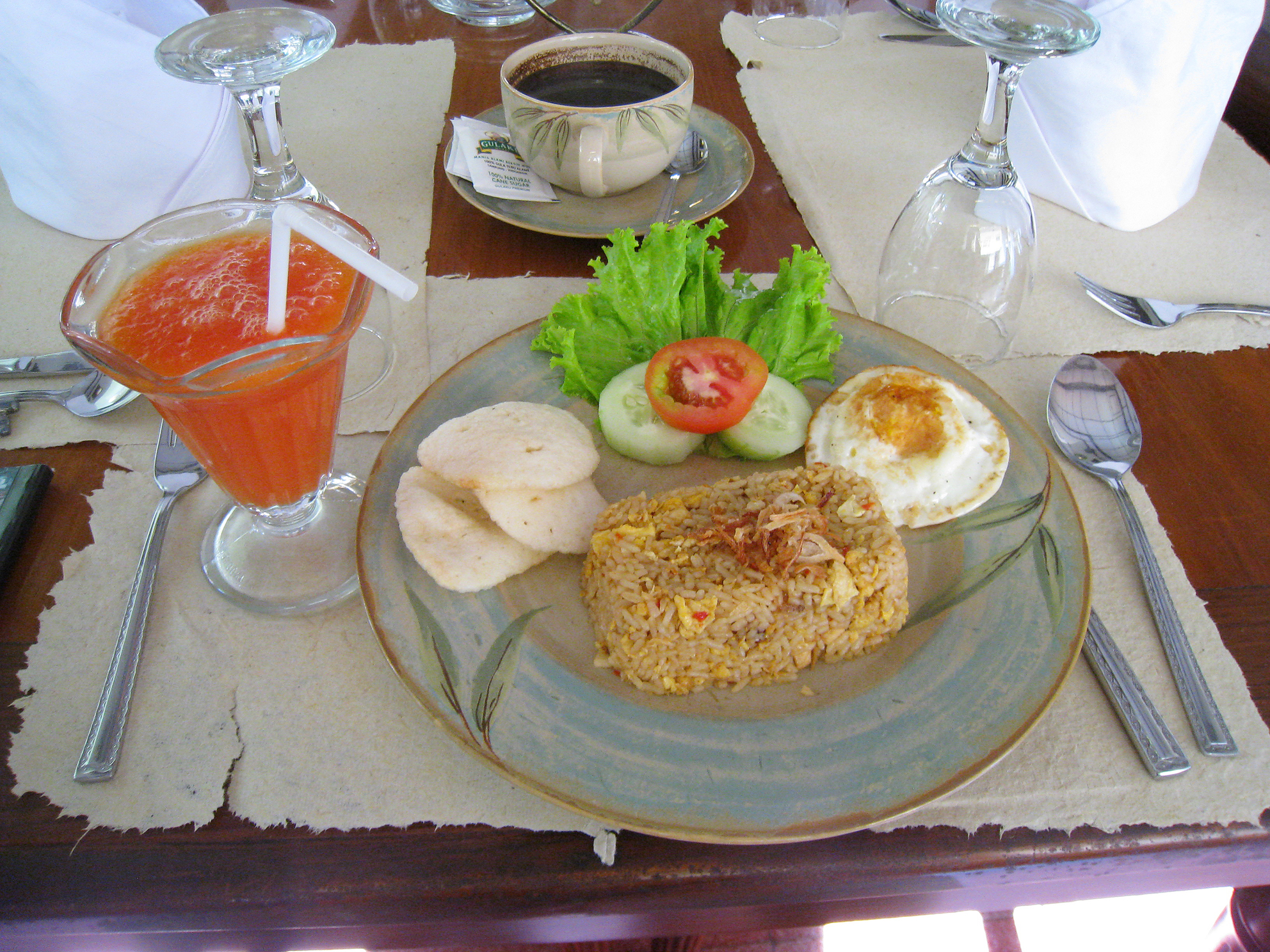
On weekdays, my wife and I usually order the usual simple dishes. One might assume that Auntie might take her time as you can hear the ladel scarping against the wok slowly in the kitchen, but she gets it dome in just a few minutes. Fried rice is usually simple, but this one is packed with eggs, pieces of chicken, shrimp, squid, fishcakes and mix-vegetables. Usually, if one of the seafood is not available, it will be counter-balanced by what is readily available.
The fried noodle dishes usually have 2 styles: wet or dry. My wife prefers dry style, while I prefer the other. Just like the fried rice, it is packed with the combined cuts of chicken and seafood, along with freshly cooked vegetables. The wet style usually has a little sauce, black in colour. It is not too thick, meaning that Auntie uses not too much corn starch, making the flavour more evident and giving the desire to customers to finish up the dish to the last drop. The fried koay-teow, dry version, has an additional taste: peanuts. I believe that crushed peanuts are used in the dish. This is not surprising because I remember, back in the 1970s, my mother used to sprinkle crushed peanuts when she makes fried koay-teow as well.
My wife's favorite is Fried Bihun. The dish is simple enough, and yet I can never emulate it in my kitchen. The strands of rice vermicelli are soft, combined with the chicken, prawns and vegetables, creating a tasty concoction that my wife enjoys with her condiment of sliced bird-chilli in soy-sauce. Unlike many Chinese cooks who have evolved to a more-Malaysian style of combining chili paste in their cooking, Uncle and Auntie remained loyal to their traditional method. If your tongue requires a little heat, you can request sliced chili, bird chili or pickled chili. I prefer the last one.
All of our dishes are always accompanied by Mixed Vegetables, which we order on every visit. It is made with fresh vegetables, depending on what is available, mushrooms; usually 2 types, chicken, shrimp, squid, fishcake, all stir-fried to perfection. The crisp vegetables, made wholesome by its accompanying cuts of meat and seafood, completes our lunch.
On Thursdays, Uncle and Auntie sell Mee Kari for breakfast, usually between 8.30 to 10.00 a.m., depending on availability. I have nor tried this as my many attempts resulted in frustrations. Yes, it sells out fast...too fast to my liking.
On weekends, if my family and I want something simple and satisfying, we would usually go to Uncle and Auntie's for a spot of lunch. Uncle himself won't remember all of the items on his previous menus, but he would recommend certain items such as curry, sotong masak sambal or/and fried chicken. We look forward to try the curry one of these days.
Paying RM4.00 for a generous portion of fried rice or the noodle dishes, loaded with chicken, egg, seafood and vegetables is really a bless. You leave the shop, wondering whether you can work on an extremely full stomach or not. I feel that it is better than some of the Menu Rakyat 1Malaysia I saw in Kuala Lumpur.
I guess Uncle and Auntie are the last in their generation to inherit the shop. Their children don't seem to show any interest as they are now working elsewhere. One of them is a university lecturer, I'm not sure about the others. I guess I better enjoy the good at Kedai Kopi Kuang Ming while it is still available. The food is good, the herbal tea cools you down on hot Alor Setar days and the ambience is very relaxed. Deep inside, I wish somebody in his family will continue the business later on and keep the delicious dishes coming for the loyal customers.
You can reach Kedai Kopi Kuang Ming below:
and here's a closer view of the location: