Thursday, September 9, 2010

Marking The End of the Ramadhan Chapter

A man with an out-of-the-state accent slammed his car horn and shouted at me as drove into my office compound and parked my car at the second entrance. It seemed that he was trying to park at the gate entrance of my office and was somehow blocked by my car. He would've blocked vehicles from coming in and/or out of the office. I guess that's what hunger does to people, if he is actually fasting, he wouldn't be doing that. Don't you think he might get equally upset if I park my car at the gate entrance of his house? Hunger and going for shopping in the chaotic situation of Alor Setar can really drive people bonkers.

Anyway, I realized that 30 days of fasting really went fast. I stopped my food business on Tuesday, and Chet's Nasi Arab stopped on Wednesday. We had a remarkable time there, tiring but satisfied. Despite cutting out pasta from my menu, we made significantly more from the sales, not to mention from the custom-made shepherd pies and milk puddings which orders I received for the first time ever. As usual, the total from the sales will all go to my son's bank account. Hey. at least one day he can say to his friends, "My dad sells kuih by the roadside every Ramadhan."

As I mentioned before, the crowd has been unusual this, despite the hues and cries of economic downturn.
Both Chet and I, for the first time, had a complete 100% sold-out this year as proof. In fact, the final week saw my stall stormed by customers and fully cleared by around 4:30-4:45pm. Most of that time, I didn't have the chance to put my hat on. This year also sees, for the first time, how this blog generated a few customers for my stall. Also, for the first time, a friend from my MRSM days, Faris, sought me out there as well. Alhamdulillah, there's so much of God's bounty, not just financially.

My kuih is just the side-show, the Nasi Arab is always the main event...and the show-stopper. Here are some pictures that depicts the every Ramadhan day scene at our stalls, mainly, Chet's Nasi Arab stall.


And with that, we would like to wish all:


Selamat Hari Raya Aidil Fitri
Maaf Zahir Batin
From: Syed Alfian Barakbah, Sharifah Rafita Shahab and Syed Muhammad Zulkifli

Wednesday, August 25, 2010

In Ramadhan

In such a blessed month, I seem to relish Ramadhan so much. In retrospect, the fasting reminds all of us of the hardships suffered by those who are not so fortunate, and our zakat hopefully will, more or less, attempt to ease their suffering.

Despite the Ramadhan buffets offered by eateries in Alor Setar, I always opt to eat at home. Simply put, I cannot eat that much for breaking of fast. My break of fast mostly consist of water which I need to replenish after a hard and hot day of activities. So far, breaking fast at my parents saw me eating half plate of rice with something very simple, like sardine or dhalca...and 2 big glasses of pandan syrup.

My schedule gets more hectic during the Ramadhan month, my mornings to late afternoon spent finishing any tasks and/or assignment at the office, and I realy hate to finish today's assignments tomorrow. Around 4pm, my Ramadhan food-stall opens at Jalan Sultanah, and so far Alhamdulillah, sales has been very good. Late evenings are spent with the family and later making the Bengkang Susu.

I started with only 1 tray of Bengkang Susu and although a bit hesitant at first, I increased the supply to 2 trays. Alhamdulillah, so far I keep going home with empty trays. This year also saw Godam (Shepherd's Pie) and my sister's Black Pepper Beef Curry Puff totally sold out. I might just add another item to the menu or my Godam might run out of stock fast. Maybe Cornish Pie will be a good addition to it. I used to sell it about 3-4 years ago, and it was quite a hot item.

My stall was visited by somebody who happened to read this blog. Apparently she was looking for shepherd's pie, and found my blog, and from the blog, found my stall. Thank you for visiting my blog, and much thanks for visiting my stall as well.

Despite the upward trend trend in the price of milk, I still manage to sell Bengkang Susu at RM0.50 a slice. However I'm just hoping that the price will not go over RM40.00 next year, or I might have to increase the price, and if I do, it will be the first time I have to do it.

Before this week, I use to scout around the hypermarkets, looking for 2kg milk packs on promotion, but now I've decided to get them straight from the wholesaler. That actually saves time and I get to relax more with my family.

With all of that on my schedule, I never realized it has been 2 weeks of the fasting month already. National Day is just next week, and Hari Raya is 10 days after that. That's fast.

I guess that every Ramadhan makes me feel closer to my life=long dream, which is running a restaurant, not a posh elite one, just a simple eatery, with limited menu items. I might not have that courage and/or the resources to set that up, but running the food stall in Ramadhan? That is something I will always cherish.

Monday, August 16, 2010

Ramadhan Food Stall, I'm Back...What, No Pasta??!

The traffic gets louder and louder, it seems, and when my cousin arrives with his big pot of Nasi Arab, there was a small traffic congestion. What am I doing? Oh yes, I’m back! My stall is open again, next to Chet’s (Syed Nasir) Nasi Arab stall.

I have to admit that I spent the past few months preparing the pies or godam, and the only difference this year is, there is no pasta, or baked macaroni with cheese. Yes, yes, I did get a surprised and sghast looks from my normal customers but what can I say? This year, I really have my hands full. This year I have to make the milk pudding (bengkang susu) as my wife is working and too tired to do it, and my sister’s schedule is as hectic as it is. So, after a day of crash course, as instructed by my wife, I did manage to produce my own bengkang susu.

There’s not much variety this year, only godam (beef shepherd’s pie), black pepper beef curry puff and bengkang susu. That’s it.

So, this Ramadhan, I’ll be in the kitchen after buka puasa to make the puddings, and in the kitchen again around 2p.m. to bake the pies, and I’ll be at the stall at 4 p.m., around the same time Chet arrives to set up his Nasi Arab Stall. We are at the same place like last year. Do drop by if you want to try something slightly different (in Alor Setar) for buka puasa.

See you there...

Tuesday, August 3, 2010

One Week To Ramadan: Filling Them Up

Ramadan is drawing up fast; in about 1 week, Muslims around the world will begin the fasting month. As usual, I've been very busy preparing for my usual fasting month Ramadan food stall. This year, it will be slightly different: as my wife will be very busy with work, I will be taking over the making of Bengkang Susu (Milk Pudding), something which I've never done before. I'm still learning under my wife's extremely patient tutelage.

I won't be making much variety this year, among the usual dish will be Godam, or our own localized Shepherd's Pie. This item may seem to be the easiest but don't be fooled, it takes patience and time, just like the Bengkang Susu. Luckily, since I've been making them for the past 4 years, I can make them slightly faster...and "slightly" is the key word.

I will share here my favorite beef-based filling for the pie, not the original as it is a trade secret, but it is up to everybody's imagination and taste on how to make it an "exploding" affair on your taste-buds.

For the filling:

500grams of minced beef (If frozen, try Ramly's. I've tried others but there's too much fat)
5-6 red onions, minced or sliced
2 Cloves Garlic (Optional)
Ground pepper (preferably coarse)
Spice/Herbs (Depends on your taste, you can use soy-sauce, Worcestershire, black pepper sauce, cumin and many more)
Beef Stock 3-4 cups
1-2 Spoonful flour
3-4 Spoonful oil
1 cup Mixed Vegetables (Optional)

Add Pepper to the beef and mix.
Heat the wok and pour the cooking oil in.
Once the oil is hot enough, put in the onions and stir fry until slightly brown
Add the beef and brown it by constantly stirring. Make sure the beef is not lumped.
Once the beef is fully cooked, put in the intended spice/herb/sauce to be wok and mix it around, cook for a further 4-5 minutes.Pour in the beef stock and keep stirring.
Let the beef and stock boil for about 1-2 minutes before adding the flour to the mixture, pending how thick you want the gravy to be.
When the gravy thickens, add in the mixed vege and salt to taste.

Once the filling is ready, it is best to let it rest for the next 10-15 minutes before using them in any pie. I usually use it when it is at room temperature. You can use
for pies, curry puffs, pastry and/or even buns.

As I have mentioned before, everything is up to your own design and desire, you don't have to follow the recipe exactly as above, let your imagination run wild every now and then because you yourself will know how your food is supposed to taste.

Try it, and you know an even better way/method of doing this, please let me know as well.

Note: I never use mixed-vege, it always results in my filling doesn't last as long as I want it to be.

Sunday, June 27, 2010

The Malaysian Cultural Show in Hawaii...16 Years Later

Time flies, and most of the time, we have no idea how fast it would be. I spent last night looking at old photographs and an old video (converted into CD, but that didn't do justice) of my student days of Hawaii, which was from 1992 to 1994. I can hardly believed it myself, it has been 16 years since I came back, started work, got married, started my business, got a son, moved back to Alor Setar and started writing a blog.

Remembering my wild rebellious days in MRSM/MSM and the-still-rebellious-yet-refined PJ Community College days, I promised my parents, friend and myself that those days were over. I was determined to start anew, a low-profile, more academic life in Hawaii Pacific University. One year later, I was elected as the President of the newly re-formed Malaysian Students Association of Hawaii Pacific Universities...I still can't figure out who put me up to it...

Among the best memories ever of being in charge of the Malaysian Students Association is organizing CentreStage : The Malaysian Cultural Performances. The show was performed at the Ala Moana Shopping Centre, the biggest shopping mall in the Asia Pacific region at that time. The idea came about when my friend Neil and I went "lepak"ing there one day, and after lunch we saw a group of little girls from pre-school performing ballet there. I asked Neil's opinion about having a Malaysian cultural show at the CentreStage and Neil replied, "It's a good idea!" and the rest is history.

The idea was met by enthusiastic supports and pessimistic criticisms. Nay-sayers condemned the Malaysians as "what the hell are they trying to prove?" which was after the months of criticising. "this malaysian association never has any activities." Well, I proved nothing, but the Malaysian guys and girls who worked so hard have proven them wrong.

This event was 15 years before the broad-scoping concept of 1Malaysia, but the spirit of Malaysia was always around. The Malay dance group comprises of Malays, Indians and Chinese; the Chinese Dance comprised of Chinese and Kadazan Dusun, choreographed by a Malay and the Indian Dance were comprised of Indian, Chinese and Indian. Even the technical and supporting crew are balanced, well, including my best friend from Singapore, Sean. Sean was the tireless photographer who actually dazzled my attention while on stage for moving from one location to another to get the perfect shot. Even Neil's brother Dev, who was actually working in Hawaii and not a student, was involved as the official video cameraman.

After more than 6 months of training at various locations, where many minor incidents occurring, the show blasted off to an auspicious start, with Azura and I became the Masters of Ceremony. Tourism Malaysia, which were based in Los Angeles, helped us a lot by providing brochures, promotional items and even costumes for the show. The brave Malaysian guys and girls were graceful and mesmerizing. I was also informed by the management of Ala Moana Shopping Centre that the Malaysians were the first to perform on stage in the shopping mall. Not only that, I was told by the Malaysian Students Association's advisor that the Malaysians were the first group to actually have the courage to perform a cultural show in a public area outside of the university campus...and this was a time even before the "Malaysia Boleh" slogan. The campus were abuzz with the name Malaysia, and the guys and girls? They were the celebrities who pulled it off.

When my term ended at the end of 1993, I managed to witness the Malaysian cultural show becoming an annual event. I came home in December 1994, and I didn't know whether the show is still around every year or not. As one of the persons who wove the fabric to full, this is one of the memories that I cherish until the day I go.

To all of those who were part of the event, Che' Aa, Nana, Sri, Siva Kuhan, Chhui Ling, Karen, Azura, Radha, Bernard, Daryl, Renu, Sean, Dev, Nei;, Eric, Poh Lin and many many more (I also realized that I can't remember some of the names, I really apologize on that), thank you for the memories. Before I forget again, here's the video...the quality has deteriorated through time and the conversion to cd doesn't make any improvement. Enjoy.

As per requirements of Youtube, the video file was split to 5 parts:

Part 1:


Part 2:


Part 3:


Part 4:


Part 5:

Monday, June 14, 2010

Kenduri Food With A Difference

It is the time of the year again, 2 weeks of school holidays. Cars, motorcycles and vans filling up the highways and roads, good restaurants crowded with people you don’t recognize, traffic jams outside my office…yes, the holidays have arrived, and I have piles of Invitation Cards to weddings of cousins, nephews, nieces etc. I guess that also adds to the reason why many people travel outside of Kuala Lumpur during the school holidays.

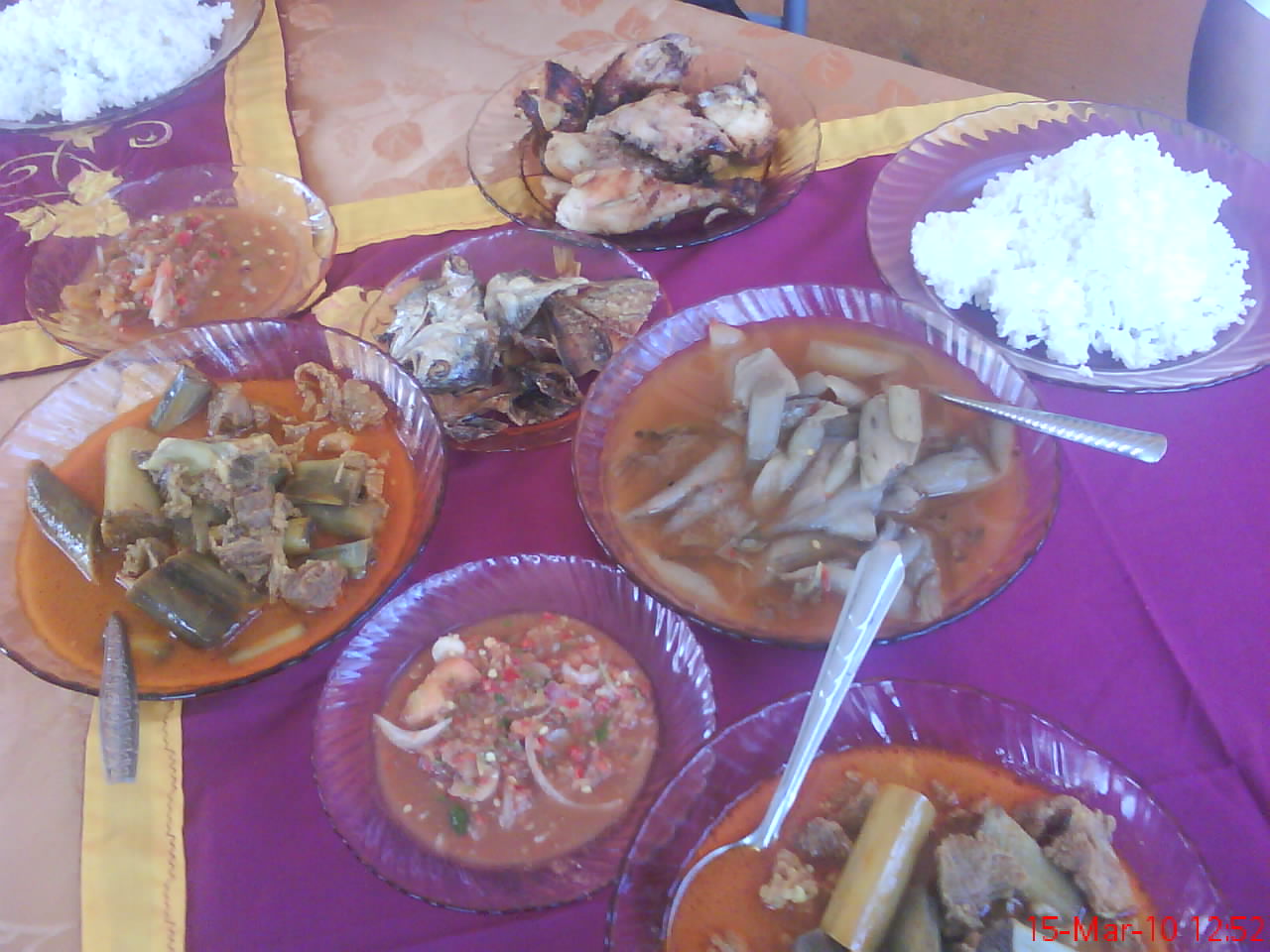
Who hasn’t been to a Malay kenduri? In Malaysia, nowadays, the kenduri has become synonymous with nasi minyak, ayam masak merah, kurma daging, dhalca and acar. I must say that will be the stereotype kenduri menu in towns and major cities. My favorite invitation is always to a kenduri in kampong areas. I remember in the 1980s, kenduris in the kampong area of Pendang means white rice, catfish curry, fried salted fish, ulam and sambal, and boy, that was a major feast.

This time, I had an invitation to a kenduri in Kuala Nerang, about 30km north of Alor Setar, and the kenduri location is about 8-10km after Kuala Nerang town itself. The kenduri itself was a grand celebration by itself: pencak silat, the traditional serunai and drums and the huge crowd. The food is really something worth braving the distance and the crowd.

The white rice, fried salted fish, roasted chicken and air asam were excellent, but behold the piece de rĂ©sistance, the Gulai Daging Batang Pisang, or Beef Curry with Banana Trunk Stem. I believe that there are those who have tasted this wonderful dish, and I know that even this dish can be found sold in certain places in Alor Setar. I’ve bought it numerous times from numerous traders, but usually end up being thrown out.

The food is prepared by the kampong people themselves; no commercialized catering food here. The curry is a bit more watery compared to the normal curries, and almost soup like, with not too much spice. The beef is fresh, and the “secret ingredient” here would be the banana tree trunk stem, which is the centre stem or fiber of the banana trunk. Once cooked, the risa is soft and the beef tender, some falling off the bone.

The banana trunk stem, or “risa” as it is known up north, must be taken from a young banana tree which has not produced any flower of fruit yet. If the risa is a from a banana tree which has produced fruit before, then it will be tasteless when it’s cooked. The risa is cooked together with the beef curry to produce the tasty, right-tasting dish which is enjoyed by the hundreds of guests throughout the kenduri.

After 2-3 kenduris in town area, this dish alone is a refreshing change from the heavy nasi minyak and ayam masak merah dishes.

As the dish is prepared by a group of people, coordinated by the head cook, early in the morning, it was quite difficult for me to figure out the process step by step. I guess this must be the kenduri food which I wouldn’t mind being invited to again and again. It is much, much, much better than the Gulai Daging Batang Pisang that is sold at the Bazaar Ramadan during the fasting season. But whatever it is, I doubt I can muster the skills of finding the right type of risa to make the curry.

I am not sure whether this curry is available at kampongs outside of Kedah, but I am sure that other kampongs in Kedah and all other states in Malaysia will have a unique recipe of their own.

Thursday, June 3, 2010

Finding That Chicken Rice: A Crowing Game


Somewhere in 1990, in Kuala Lumpur, I managed to sample Hainanese Chicken Rice. This shouldn't be a surprise as, being in Malaysia, chicken rice is available everywhere. But this chicken rice stopped me in the tracks, the taste was very good. I was told that that was the authentic chicken rice, the way it was created and the way it should be.

Twenty years have passed, and being in Alor Setar, looking for that perfect Chicken Rice becomes a challenge. I understand that, for non-Muslims, it's no problem as there Chinese eating places that offer chicken rice everywhere. People in Kuala Lumpur should be lucky in this sense as there are now many halal Chinese restaurants available with this cuisine.

Chicken rice traces its origins from Hainan, China. Hainanese who came to Malaysia in the past introduced this dish and enriched the Malaysian F&B culture, although it can also be found everywhere in Thailand as well. It didn't take long before Malaysianized varieties took over and variations of the chicken rice rise to the fore. The Malays' chicken rice usually has more spices, such as cinnamon and cardamom in it. The rice also has turmeric in it. One of the major differences would be that the chicken is deep fried instead of boiled in the traditional bath. The fried chicken is usually a bit dry compared to the moist and tender boiled/steamed Hainanese style.

The chili sauce also plays a major factor. The Hainanese chicken rice usually has a mild sauce, a more potent garlic and ginger combination. The Malays have a stronger chili taste. There are also some shops that cheat by using bottled chili sauce. Nowadays, even the Chinese in Malaysia prefer the sauce to be hotter, causing their sauce to evolve erratically.

Chicken rice actually is not one of my favorite items on the menu. This actually is caused by the frustrating search for the more-original taste and style of the Hainanese chicken rice. I must say that I am not that fond of the Malay chicken rice as the chicken is dry and the sauces never work well. Of course, I am NOT saying that the Malays' chicken rice is not good as I find quite a number of Chinese eating the Malays' chicken rice, this is more on personal taste and preference.

Fate played a different game when I was at the Star Parade Alor Setar's Food Court. I usually go to Star Parade, a shopping complex in Alor Setar, when there are not many people around. My usual haunt at the food court would be the Lebanese Food. However, I was looking for something simpler and decided to head to the Nasi Ayam counter, and they somehow managed to surprise me with their dish.

The Chicken Rice tastes more Hainanese than Malay. The rice is lightly seasoned and fluffy, instead of the usual turmeric-colored, anise-seed scented one. There is a subtle taste of margarine and chicken fat along with stock in the rice. The chicken, although fried, is moist on the inside and retains the usual taste one would expect from the original chicken rice, served with pieces of cucumber, chili sauce and the chicken-stock based soy sauce. I have a feeling that the chili sauce has been modified for a sweet and hotter taste. You can easily detect the chicken stock in the soy sauce which gives it a more uplifting taste without being too salty. A bowl of simple chicken soup completes the dish.

By chance I met the stall operator, Encik Jamal. By experience, he was a chef who has been almost everywhere in Malaysia's top hotel before choosing to retire. I did ask him why chicken rice, despite all the experiences and knowledge gained throughout his years as a chef. Encik Jamal explained that he did try to sell Western food but the preparation hassle and people's acceptance in Alor Setar made him lose interest. I would have to agree. In Alor Setar, for most people (not all), Chicken Chop is considered the utmost western food. Spaghetti is to be eaten only with bolognaise (beef/mushroom with tomato paste) sauce. If you give them Angel Hair (pasta) with cream and parmesan sauce, they might just run away.

Encik Jamal explained that even his chicken rice met with certain antagonistic threats when he started his business. The original Hainanese chicken rice requires the chicken to be cooked in a vinegar based bath, once done it will be hung and chopped when it is to be served. People (mostly Malays) complained that this is not chicken rice or the chicken is not even cooked. He made changes by cooking the chicken in the bath, hung it, and when cooled, fried in oil to get the caramelized crispy skin texture that has become his own trademark.

He estimates his sales to be around 10-12 chicken per day on a normal day, and 12-15 on weekends and holidays. By now, he has regulars who have been captivated by chicken rice that differs from all Malay chicken rice in Alor Setar. Of course, I might be wrong, please correct me on this.

The bath for the chicken is a combination of white and black vinegar, along with maltose that give the chicken the crispy skin, and a light endearing taste. This is an extreme change from the usual crispy but dry and bland chicken I end up with at most chicken rice stalls.

Encik Jamal's Chicken Rice stall is located at the Food Court, which is on the 4th floor of Star Parade, Jalan Telok Wanjah, Alor Setar, Kedah. The stall is situated next to the Lebanese food. The stall starts around 10am until 6pm. A set of Chicken Rice costs around RM3.50.

I might not end up with the 100% authentic chicken rice, but the proximity in this case, is closer than before. Thinking about it, I think I found a Chicken Rice stall worth revisiting, again and again.